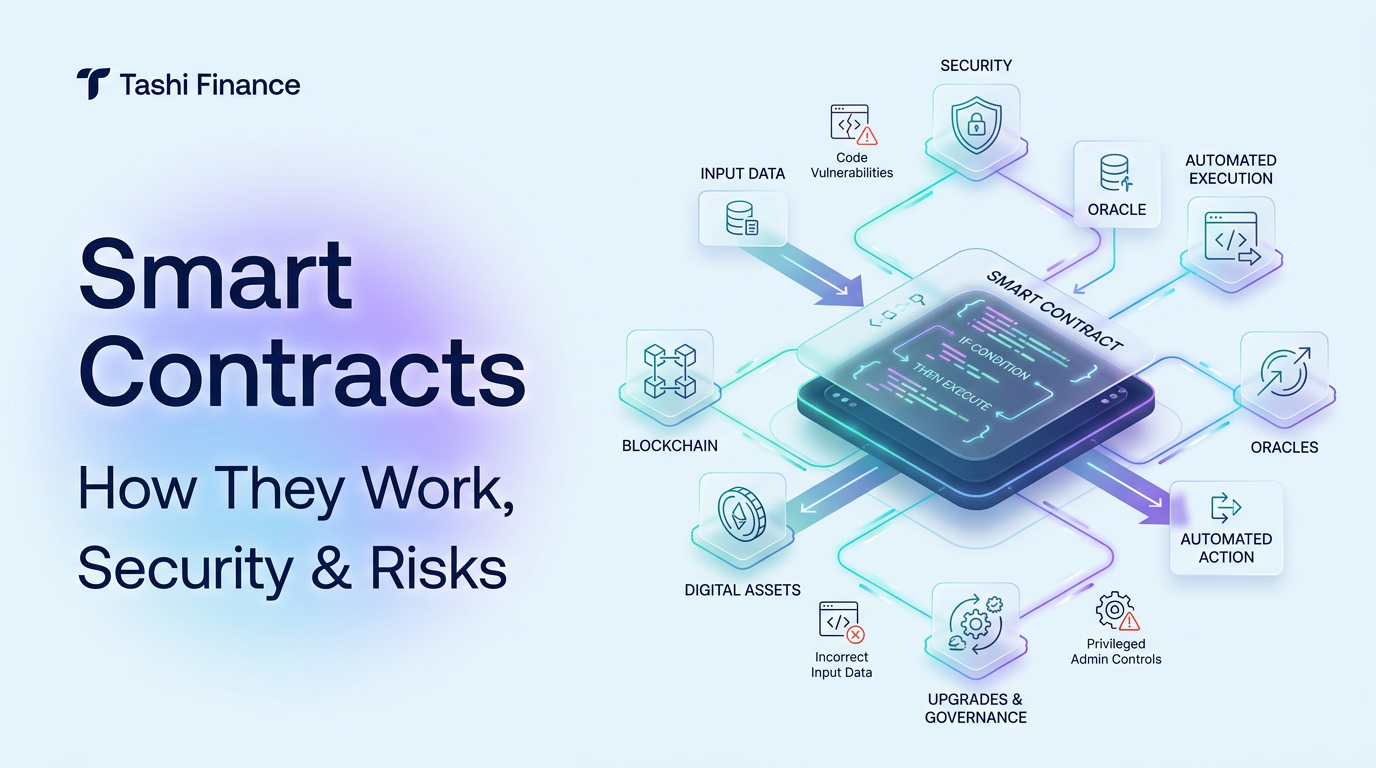
What Is a Smart Contract? How It Works, Applications, Security, and Risks
A smart contract is a program deployed on a blockchain that executes predefined instructions when specified conditions are met. Smart contracts can transfer digital assets, update records, enforce protocol rules, or automate transactions. They do not independently understand intent or judge whether an outcome is fair; they execute the logic encoded in the program.
The term smart contract can create two common misunderstandings.
First, a smart contract is not necessarily “smart” in the sense of artificial intelligence.
Second, a smart contract is not automatically a legally enforceable contract.
At its core, it is software.
The program receives inputs, checks conditions, changes blockchain state, and performs actions according to rules written into its code.
This distinction matters because software can execute exactly as programmed while still producing an outcome that users did not expect.
The most useful question is therefore not simply:
Can this process be automated with a smart contract?
A better question is:
Are the rules, data, permissions, and failure conditions clear enough that automatic execution is actually desirable?
What Is a Smart Contract?
A smart contract is executable software that operates within a blockchain environment.
The program defines rules describing what should happen when particular conditions are satisfied.
A simplified rule might look like this:
If Condition A is true → Execute Action B
For example:
If payment is confirmed → Transfer a digital asset
or:
If collateral falls below a required threshold → Allow liquidation
The blockchain provides the infrastructure for recording and executing these instructions.
Depending on the network, multiple participants validate transactions and agree on the resulting blockchain state.
The smart contract provides the application logic.
These are separate layers.
What Are Smart Contracts?
Smart contracts are programs designed to automate actions involving blockchain-based data and assets.
Smart contracts may control:
- digital tokens;
- ownership records;
- payments;
- collateral;
- voting systems;
- access permissions;
- financial protocols.
A smart contract can also interact with another smart contract.
This allows developers to combine multiple programs into larger applications.
For example, one protocol might use:
- one contract for asset custody;
- another for pricing logic;
- another for governance;
- another for user permissions.
This flexibility makes smart contracts powerful.
It also creates complexity because a failure in one component can affect several connected components.
How Does a Blockchain Handle Smart Contracts?
When a user interacts with a smart contract, the blockchain processes the interaction as a transaction or state-changing request.
A simplified sequence looks like this:
- A user or application creates a transaction.
- The transaction identifies the smart contract and requested function.
- The transaction is submitted to the blockchain network.
- The network executes the contract logic according to the blockchain’s rules.
- The contract checks relevant conditions.
- The resulting state changes are validated.
- The updated state becomes part of the blockchain record.
The exact process differs between blockchain architectures.
However, the fundamental principle is similar:
Every network participant validating the transaction should reach the same result when executing the same smart contract logic with the same valid inputs.
This requirement is one reason smart contract execution must be deterministic.
The program cannot simply produce random or inconsistent results across different network participants.
Smart Contract Execution: A Simple Example
Imagine a digital escrow system.
A buyer wants to purchase a digital asset from a seller.
The smart contract might follow these rules:
- Buyer deposits payment.
- Contract holds the payment.
- Required condition is confirmed.
- Contract transfers payment to seller.
- Digital asset is transferred to buyer.
In theory, this can reduce the need for an intermediary to manually process every transaction.
But important questions remain.
Who confirms that the required condition occurred?
What happens if the wrong asset is delivered?
What happens if external information is incorrect?
The code can automate execution.
It does not automatically solve every dispute surrounding the transaction.
Smart Contracts Are Not Artificial Intelligence
The word “smart” is misleading.
A typical smart contract does not independently:
- understand context;
- interpret human intention;
- negotiate terms;
- decide what is fair;
- correct badly designed rules.
The contract follows programmed logic.
Consider this rule:
If payment received → Transfer asset
The smart contract can verify whether the blockchain shows the required payment.
But the contract does not inherently understand whether:
- the buyer was deceived;
- the asset was misrepresented;
- the agreement was entered under incorrect assumptions.
The code sees conditions.
Humans see context.
This creates one of the most important limitations of automated financial agreements.
Smart Contract vs Traditional Contract
A smart contract and a traditional legal contract are not necessarily the same thing.
| Smart Contract | Traditional Contract |
|---|---|
| Executable software | Legal or commercial agreement |
| Follows coded rules | Interpreted through legal language |
| Can automate actions | May require human enforcement |
| Executes based on defined inputs | Can consider broader circumstances |
| Difficult to change after deployment in some designs | May be amended by agreement |
| Technical failure is a major risk | Legal interpretation is a major issue |
A legal agreement can use smart contract technology.
But deploying code does not automatically answer every legal question.
The code may represent only one part of a larger contractual relationship.
Smart Contracts and Blockchain Technology
Smart contracts rely on blockchain technology for transaction execution, state management, and shared verification.
The blockchain provides the environment in which the contract operates.
The smart contract provides the rules of the application.
This distinction matters because not every blockchain supports the same smart contract capabilities.
Different networks can have different:
- programming environments;
- transaction costs;
- execution limits;
- security models;
- upgrade mechanisms.
A smart contract designed for one blockchain may therefore behave differently or require significant changes on another.
Smart Contract Applications
Common smart contracts applications can be grouped into several areas.
Decentralized Finance
Smart contracts can manage lending, borrowing, trading, collateral, and liquidity.
Digital Assets
Programs can issue, transfer, or manage blockchain-based assets.
Tokenization
Smart contracts can define rules for transferring tokens representing economic or ownership rights.
Escrow
Assets can be held until predefined conditions are satisfied.
Governance
Token holders or participants can vote on proposed changes.
Supply Chain Processes
Smart contracts can automate actions connected to shared supply chain records.
Digital Identity and Access
Applications can use blockchain-based permissions to control access.
The value of a smart contract depends on whether automatic execution improves the underlying process.
Using a blockchain simply because automation is possible does not guarantee a better system.
Smart Contracts in DeFi
Smart contracts form a major part of decentralized finance infrastructure.
A DeFi lending protocol, for example, may use smart contracts to define:
- which assets can be deposited;
- how much users can borrow;
- interest calculations;
- collateral requirements;
- liquidation conditions.
A decentralized exchange may use smart contracts to manage:
- liquidity pools;
- token swaps;
- trading fees.
This reduces dependence on manual transaction processing.
However, it also means financial risk can become embedded directly into code.
A badly chosen liquidation rule can create losses even when the smart contract executes correctly.
Smart Contracts and Digital Assets
Smart contracts can control many types of digital assets.
For example, a contract may define:
- token supply;
- transfer permissions;
- ownership records;
- transaction restrictions.
But the blockchain record and the economic rights associated with an asset are separate questions.
A smart contract can reliably record that Wallet A controls Token B.
That does not automatically determine what Token B represents in the real world.
If a token is supposed to represent:
- property;
- securities;
- commodities;
- contractual rights;
the connection between the token and the underlying asset may depend on legal and operational structures outside the blockchain.
What Is Smart Contract Development?
Smart contract development is the process of designing, coding, testing, deploying, and maintaining blockchain-based programs.
The process should begin before code is written.
A well-designed development workflow usually includes:
- Defining the business problem.
- Identifying required participants.
- Defining contract states and rules.
- Identifying trusted and untrusted inputs.
- Designing permissions.
- Writing the contract code.
- Testing expected behavior.
- Testing failure conditions.
- Performing security review.
- Deploying the contract.
- Monitoring the system.
The most difficult part is often not writing the code.
It is defining exactly what the code should do when unusual conditions occur.
The Smart Contract Development Mistake: Coding Too Early
A common project failure begins with the technology.
The team decides:
We need a smart contract.
Then it attempts to design a business process around the technology.
The better sequence is:
Define problem → Identify trust assumptions → Define rules → Evaluate architecture → Decide whether a smart contract is appropriate
Starting with code can hide important questions.
For example:
- Who can change the rules?
- Who can pause the system?
- What happens if data is unavailable?
- What happens if one participant disappears?
- How are disputes handled?
These are architecture and governance questions.
They should not be discovered only after deployment.
Smart Contract State
A smart contract can store or manage state.
State represents information that changes over time.
For example, a lending contract might track:
- deposits;
- debts;
- collateral balances.
A token contract might track:
- total supply;
- wallet balances;
- permissions.
When a valid transaction changes the state, the blockchain records the updated result.
This creates predictable automation.
But it also means developers must carefully define every valid state transition.
An unexpected transition can create unintended behavior.
Why Smart Contract Logic Matters More Than Code Quality Alone
A smart contract can contain technically correct code while implementing a bad financial rule.
Consider a contract that says:
Liquidate collateral whenever price falls below X
The software may execute perfectly.
But perhaps X was designed poorly.
The resulting liquidation can still harm users.
This creates an important distinction:
Code correctness
is not the same as:
Business logic correctness
and neither guarantees:
A good economic outcome
Security reviews should therefore examine both technical implementation and economic assumptions.
Smart Contract Security
Smart contract security focuses on preventing unauthorized or unintended behavior in blockchain applications.
Security issues can arise from several sources.
Access Control Errors
A function may be available to users who should not have permission to execute it.
Logic Errors
The program may correctly execute an incorrectly designed rule.
External Call Risk
A contract interacting with another contract may experience unexpected behavior.
Oracle Risk
The contract may receive incorrect or manipulated external data.
Upgrade Risk
An administrator may have the ability to change important contract logic.
Dependency Risk
A contract may rely on external protocols that later fail.
Security is therefore broader than searching for one coding vulnerability.
The Smart Contract Oracle Problem
Smart contracts can directly access blockchain data.
They cannot inherently know every fact that exists outside the blockchain.
Suppose a smart contract needs to know:
- the market price of an asset;
- whether a shipment arrived;
- the result of an event.
The contract may need an external data provider commonly called an oracle.
The process may look like this:
Real-world event → Oracle → Smart Contract → Automated action
This creates a dependency.
If the oracle provides incorrect information, the smart contract may execute the wrong action while following its own code perfectly.
Therefore:
A smart contract can be technically secure while the overall application remains vulnerable to unreliable external data.
The Input Problem
The oracle issue is part of a larger problem.
Smart contracts can only make decisions using the information available to them.
Consider a supply chain contract.
The blockchain records:
Shipment delivered
The contract automatically releases payment.
But what if someone entered false information stating that the shipment was delivered?
The blockchain can preserve the false record accurately.
The smart contract can execute based on that record correctly.
The final result can still be wrong.
Automation does not automatically verify the truth of every input.
Smart Contract Audits
A smart contract audit is a structured review intended to identify security weaknesses, coding errors, and other risks.
An audit can examine:
- contract logic;
- permissions;
- external calls;
- potential vulnerabilities;
- upgrade mechanisms.
Audits can reduce risk.
They cannot guarantee that a contract is completely secure.
This is an important misconception.
A security audit evaluates a particular version of code under particular assumptions.
Problems may still appear because of:
- missed vulnerabilities;
- later upgrades;
- new integrations;
- unexpected market behavior.
The correct interpretation is:
An audit is one layer of risk management, not a permanent certificate of safety.
The Audit Snapshot Problem
Imagine a contract receives a successful security review.
Six months later, developers add a new integration.
The original smart contract code has not necessarily changed.
But the system now depends on another external protocol.
The application’s risk profile has changed.
This demonstrates an important principle:
Smart contract security is a system property, not only a code property.
A secure contract can become part of an unsafe system through new dependencies.
Immutable vs Upgradeable Smart Contracts
Smart contracts are often described as immutable.
That description requires context.
Some deployed contract code may be difficult or impossible to change directly.
However, developers can design systems that allow upgrades through mechanisms such as:
- proxy contracts;
- administrative controls;
- governance decisions.
This creates a tradeoff.
Immutable Contract
Advantages:
- rules are harder to change unexpectedly;
- users can know the deployed logic remains fixed.
Disadvantages:
- bugs can be difficult to correct.
Upgradeable Contract
Advantages:
- problems can potentially be fixed;
- functionality can evolve.
Disadvantages:
- someone may have power to change the system.
Therefore:
A system can use immutable blockchain records while still having upgradeable application logic.
Users should distinguish between blockchain immutability and application governance.
The Admin Key Risk
An application may market itself as decentralized while an administrator still has powerful permissions.
An admin key might allow someone to:
- pause the protocol;
- change parameters;
- upgrade contracts.
These capabilities can be useful during emergencies.
They also introduce centralized control.
The correct question is not simply:
Is this smart contract decentralized?
A better question is:
Which functions can still be controlled by privileged participants?
Smart Contract Composability
Smart contracts can interact with other smart contracts.
This capability is known as composability.
For example:
Contract A → calls Contract B → which depends on Contract C
This allows developers to build complex systems quickly.
It also creates dependency risk.
A problem in Contract C can affect applications built on top of it.
Users may therefore have indirect exposure to contracts they never intentionally selected.
Why Connected Smart Contracts Can Amplify Failure
Imagine:
- Protocol A uses a stablecoin.
- Protocol B accepts Protocol A’s assets as collateral.
- Protocol C depends on Protocol B.
A failure affecting the first layer may spread through the entire chain.
The individual smart contracts may each behave according to their rules.
The combined system can still experience cascading losses.
This creates another important Information Gain point:
Smart contracts reduce manual coordination, but composability can increase system-level dependency.
Smart Contract Security vs Blockchain Security
A secure blockchain does not guarantee that every smart contract running on it is secure.
These are separate layers.
Blockchain Security
Concerns include:
- transaction validation;
- consensus;
- network integrity.
Smart Contract Security
Concerns include:
- application code;
- permissions;
- logic;
- external integrations.
A blockchain can continue operating normally while a specific smart contract suffers a major vulnerability.
The blockchain may simply record the resulting transactions accurately.
Common Smart Contract Misconceptions
“Smart Contracts Understand What I Intended”
They do not.
They follow programmed rules.
“Smart Contracts Are Automatically Legal Contracts”
Not necessarily.
Legal enforceability depends on jurisdiction and agreement structure.
“Blockchain Makes Bad Data Accurate”
It does not.
Blockchain can preserve inaccurate data.
“An Audit Means the Contract Is Safe Forever”
It does not.
New vulnerabilities and integrations can change risk.
“Immutable Means Nothing Can Ever Change”
Application systems can include upgrade mechanisms.
“No Company Controls the Contract”
Some contracts retain powerful administrative permissions.
“Correct Code Guarantees a Good Outcome”
Correct code can execute bad economic rules perfectly.
When Smart Contracts Are the Wrong Solution
A smart contract may add unnecessary complexity when:
- one trusted organization already controls the process;
- transactions need frequent reversal;
- human judgment is essential;
- input data cannot be reliably verified;
- privacy requirements conflict with the chosen blockchain;
- ordinary database automation can solve the problem more efficiently.
Automation alone is not enough to justify blockchain infrastructure.
A centralized software application can also automate business rules.
The reason for choosing a smart contract should involve meaningful requirements related to shared execution, asset control, or multi-party coordination.
A Better Smart Contract Decision Framework
Before developing a smart contract, ask these questions.
| Question | Why It Matters |
|---|---|
| What process is being automated? | Defines the real use case |
| Which participants are involved? | Identifies coordination needs |
| What assets can the contract control? | Determines financial exposure |
| What external data is required? | Reveals oracle risk |
| Who has administrative permissions? | Identifies centralized control |
| Can the contract be upgraded? | Defines governance tradeoffs |
| What happens when the code fails? | Tests recovery planning |
| What happens when the code works but the business assumption fails? | Reveals economic risk |
The final question is particularly important.
Many smart contract discussions focus entirely on software bugs.
Financial systems can fail even when the software contains no obvious technical vulnerability.
A Smart Contract Can Work Perfectly and Still Produce a Bad Outcome
Consider a lending smart contract.
The system:
- receives accurate market prices;
- calculates collateral correctly;
- reaches the liquidation threshold;
- sells the user’s collateral.
Every technical component works.
The user loses money.
Nothing was hacked.
This example demonstrates why smart contract risk has two major dimensions:
Technical risk
and
economic risk
A secure application can still expose users to significant financial losses.
How Businesses Should Approach Smart Contract Development
Businesses evaluating smart contracts should begin with process design.
Step 1: Define the Business Rule
What exactly should the application automate?
Step 2: Identify Required Data
Which inputs are available directly on-chain?
Which require external information?
Step 3: Define Permissions
Who can:
- use the contract;
- modify settings;
- pause operations?
Step 4: Model Failure Cases
What happens if:
- the oracle fails;
- the network is congested;
- another protocol fails;
- an administrator loses access?
Step 5: Test Extreme Conditions
Normal operation is not enough.
The system should also be evaluated under unusual conditions.
Step 6: Review and Audit
Independent review can help identify weaknesses.
Step 7: Monitor After Deployment
Deployment is not the end of the security process.
Connected systems and market conditions can change.
Frequently Asked Questions
What is a smart contract?
A smart contract is a blockchain-based program that executes predefined instructions when specified conditions are met. Smart contracts can automate transfers, financial rules, permissions, and other digital processes.
What are smart contracts?
Smart contracts are executable programs deployed on blockchain networks. They allow applications to automate actions according to coded rules.
How does a blockchain handle smart contracts?
A blockchain processes transactions that call smart contract functions. Network participants execute or validate the contract logic and record the resulting state changes according to the blockchain’s rules.
What is a smart contract in blockchain?
A smart contract in blockchain is an application program whose code and state are managed through blockchain infrastructure.
What are common smart contract applications?
Applications include decentralized finance, digital assets, tokenization, escrow, governance, and automated business workflows.
Are smart contracts legally binding?
Not automatically. A smart contract is software. Whether its use creates or supports a legally enforceable agreement depends on the legal structure and jurisdiction.
Can smart contracts be changed?
Some smart contracts are designed to be immutable, while other systems use upgrade mechanisms that allow authorized participants or governance processes to modify application logic.
What is smart contract security?
Smart contract security involves protecting blockchain applications from coding errors, access-control problems, oracle failures, unsafe dependencies, logic mistakes, and other vulnerabilities.
Does a smart contract audit guarantee security?
No. An audit can identify risks but cannot guarantee permanent security. Later upgrades, integrations, or previously undiscovered vulnerabilities can change the system’s risk profile.
Can a smart contract work correctly and still cause losses?
Yes. A smart contract can correctly execute financial rules that result in liquidation, market losses, or other undesirable outcomes. Technical correctness does not eliminate economic risk.
What is smart contract development?
Smart contract development is the process of designing, coding, testing, reviewing, deploying, and monitoring blockchain-based application logic.
Final Takeaway
A smart contract is software that automates predefined rules through blockchain infrastructure.
Its greatest strength is predictable execution.
Its greatest limitation is also predictable execution.
A smart contract does not naturally understand:
- fairness;
- intention;
- context;
- unusual circumstances.
It executes the rules it receives.
This is why successful smart contract development requires more than secure programming.
Developers and businesses must also consider:
- business logic;
- external data;
- governance;
- upgradeability;
- dependencies;
- financial incentives.
The most important question is therefore not:
Is the smart contract code working?
A better question is:
Is the entire system producing the intended outcome when the code, external data, market conditions, and connected applications interact?
That is the difference between evaluating smart contract code and evaluating a real smart contract system.
