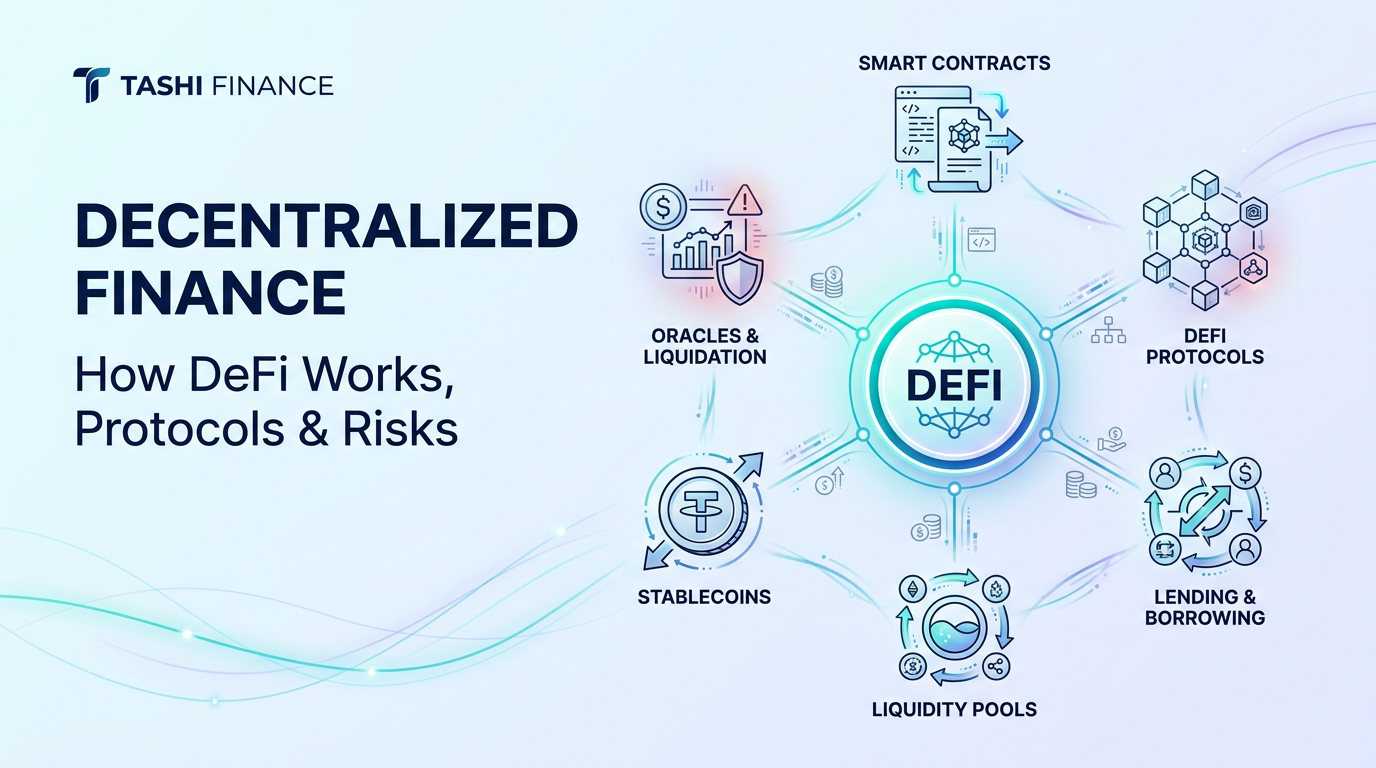
What Is DeFi? How Decentralized Finance Works, Protocols, and Risks
Decentralized finance, or DeFi, is a system of blockchain-based financial applications that use smart contracts to provide services such as trading, lending, borrowing, and asset exchange. Instead of relying entirely on traditional financial intermediaries, DeFi protocols execute predefined rules through software and allow users to interact directly with digital financial infrastructure.
The word decentralized can make DeFi sound simpler than it really is.
A user connects a wallet.
A smart contract executes a transaction.
No bank branch or traditional broker appears in the process.
But that does not necessarily mean every part of the system is decentralized.
A DeFi application may still depend on:
- developers;
- governance systems;
- price oracles;
- blockchain infrastructure;
- stablecoins;
- web interfaces;
- liquidity providers.
Understanding DeFi therefore requires more than asking whether a bank is involved.
The more useful question is:
Which parts of the financial process have been replaced by software, and which new dependencies have appeared instead?
That distinction reveals both the potential and the risks of decentralized finance.
What Is Decentralized Finance?
Decentralized finance describes financial applications built primarily on programmable blockchain networks.
These applications can provide services that resemble parts of traditional finance, including:
- asset trading;
- lending;
- borrowing;
- collateralized credit;
- liquidity provision;
- derivatives;
- asset management.
Instead of a traditional institution manually controlling every transaction, much of the process can be governed by smart contracts.
Smart contracts are programs that execute predefined instructions when specified conditions are met.
For example, a lending protocol may automatically calculate:
- collateral requirements;
- borrowing rates;
- repayment obligations;
- liquidation thresholds.
This can make financial processes more automated.
But automation does not remove financial risk.
It changes how that risk is managed.
DeFi Meaning in Crypto
The DeFi meaning in crypto refers specifically to financial services operating within blockchain and digital asset ecosystems.
A DeFi user may interact with:
- cryptocurrencies;
- stablecoins;
- tokenized assets;
- blockchain-based financial instruments.
These assets can be deposited into smart contracts that perform particular financial functions.
For example, a user might:
- deposit a digital asset into a lending protocol;
- use that asset as collateral;
- borrow another digital asset;
- interact with another protocol using the borrowed funds.
This ability for different applications to interact with one another is one of DeFi’s defining characteristics.
It is also one of its major sources of complexity.
How Does DeFi Work?
Most DeFi systems combine several technological and financial layers.
A simplified structure looks like this:
User → Wallet → DeFi Application → Smart Contract → Blockchain
Additional components may include:
- price oracles;
- liquidity pools;
- stablecoins;
- governance mechanisms;
- other DeFi protocols.
Consider a basic lending transaction.
A user deposits cryptocurrency as collateral.
A smart contract records the collateral.
The protocol allows the user to borrow another asset according to predefined rules.
The value of the collateral is monitored.
If the collateral becomes insufficient, the smart contract may trigger liquidation.
No loan officer needs to manually approve every step.
But the system still depends on rules determining:
- accepted collateral;
- collateral value;
- borrowing limits;
- liquidation thresholds.
DeFi therefore replaces some human and institutional decisions with programmable rules.
The Main Components of DeFi
| Component | Role |
|---|---|
| Blockchain | Records transactions and executes applications |
| Smart contract | Automates financial rules |
| Wallet | Allows the user to interact with protocols |
| Digital asset | Provides value used in transactions |
| Oracle | Supplies certain external information |
| Liquidity pool | Provides assets for trading or lending |
| Governance system | Helps determine protocol rules |
Different protocols combine these components in different ways.
Understanding the underlying components is more important than memorizing individual platform names.
What Are DeFi Protocols?
DeFi protocols are software-based systems that provide financial functions through blockchain infrastructure.
A protocol is usually defined by smart contracts and rules that determine how users and assets interact.
Common categories include:
- decentralized exchanges;
- lending protocols;
- liquidity protocols;
- derivatives platforms;
- yield aggregators.
The important distinction is between a protocol and a user interface.
The protocol is the underlying smart-contract system.
The website a user visits may simply be one interface for interacting with it.
This creates an interesting form of partial decentralization.
The smart contracts may continue operating even if a particular website disappears.
But users may still depend heavily on centralized interfaces because interacting directly with blockchain contracts can be technically difficult.
Decentralized Exchanges
A decentralized exchange, or DEX, allows users to exchange digital assets through smart contracts.
Unlike a conventional centralized exchange, a DEX may not require users to deposit their assets into an exchange-controlled account before trading.
Instead, users can interact using blockchain wallets.
Some decentralized exchanges use an order-book model.
Others rely on liquidity pools.
The liquidity-pool model has become particularly important in DeFi.
What Is a Liquidity Pool?
A liquidity pool is a collection of digital assets deposited into a smart contract.
These assets can be used to support activities such as:
- trading;
- lending;
- borrowing.
Users who contribute assets are commonly called liquidity providers.
In return, they may receive:
- transaction fees;
- interest;
- protocol incentives.
A simplified example might involve a pool containing two assets.
Traders exchange one asset for the other using the liquidity available in the pool.
The exact price mechanism depends on the protocol.
This removes the need for every trade to have a specific buyer and seller manually matched at the same moment.
However, the pool introduces its own risks.
Liquidity Is Not the Same as Money Sitting Safely in an Account
One common misconception is that assets deposited into a DeFi pool are equivalent to money stored in a traditional deposit account.
They are not.
Assets in a DeFi protocol may be exposed to:
- smart contract risk;
- market risk;
- liquidity risk;
- token risk;
- oracle risk;
- protocol dependencies.
The return offered by a protocol should therefore be considered together with the risk required to generate it.
A higher yield is not automatically free additional income.
In many cases, it represents compensation for taking additional forms of risk.
DeFi Lending
DeFi lending protocols allow users to supply digital assets that other participants can borrow.
A typical system works through shared pools.
Lenders deposit assets.
Borrowers provide collateral and borrow from the available liquidity.
Interest rates may change according to:
- supply;
- borrowing demand;
- utilization of the pool.
This creates a financial market managed partly through software rather than individual negotiations between lenders and borrowers.
Why DeFi Loans Are Often Overcollateralized
Traditional lenders can evaluate borrowers using information such as:
- income;
- employment;
- credit history;
- business financial statements.
Many DeFi protocols do not have access to this information.
A blockchain wallet may be identifiable as an address but still provide little information about the person’s ability or willingness to repay.
As a result, many DeFi loans require borrowers to deposit collateral worth more than the amount being borrowed.
For example, a borrower might need to provide $150 worth of digital assets to borrow $100.
This may appear inefficient from a traditional credit perspective.
But the purpose is different.
The protocol is not primarily evaluating the borrower’s future income.
It is managing the risk through collateral that can be automatically liquidated.
This explains one of the major differences between DeFi lending and traditional consumer credit.
What Is DeFi Liquidation?
A liquidation can occur when the value of a borrower’s collateral falls below a required level.
Suppose a user deposits volatile cryptocurrency as collateral.
They then borrow a stablecoin.
If the price of the collateral falls significantly, the loan becomes riskier.
A DeFi protocol may automatically allow or trigger liquidation to protect the system.
A simplified sequence is:
Collateral price falls → Collateral ratio falls → Liquidation threshold reached → Collateral is sold
This can happen quickly because the process is governed by software.
The borrower may not receive the same type of negotiation or restructuring that might exist in some traditional lending relationships.
The Liquidation Cascade Problem
Automatic liquidation can protect individual lending protocols.
But when many positions use similar collateral, falling prices can create a feedback loop.
Consider the following sequence:
Asset price falls
↓
Multiple positions reach liquidation thresholds
↓
Collateral is sold
↓
Additional selling pressure enters the market
↓
Price falls further
↓
More positions become eligible for liquidation
The system is functioning exactly as designed.
Yet the combined effect of many correct automated actions can amplify market stress.
This is an important distinction between:
Smart contract execution risk
and
system-level financial risk.
The code does not necessarily need to fail for the financial outcome to become unstable.
What Are Oracles in DeFi?
Blockchain smart contracts generally need a reliable way to obtain certain information about the outside world.
A lending contract, for example, may need to know the current market price of collateral.
An oracle provides information that smart contracts can use.
This information may include:
- asset prices;
- exchange rates;
- other external data.
Without accurate information, a smart contract may make the wrong decision while still following its programming perfectly.
The Oracle Problem
Consider a lending protocol that should liquidate collateral when its market value falls below $100.
The smart contract receives a price suggesting the collateral is worth $110.
In reality, the market price has already fallen to $80.
The contract may decide not to liquidate because the data it received is inaccurate or outdated.
The problem is not necessarily the smart contract.
The problem is its input.
This creates an important DeFi principle:
A smart contract can execute its rules perfectly and still produce a bad result when the information entering the contract is wrong.
The security of a DeFi application therefore depends partly on the systems supplying its data.
Smart Contract Risk
Smart contracts automate financial processes.
They can also contain:
- coding errors;
- design mistakes;
- unexpected interactions.
Once significant funds are controlled by a smart contract, weaknesses can become financially important.
A protocol may attempt to reduce this risk through:
- testing;
- code audits;
- security reviews;
- restricted upgrades.
None of these measures guarantees that every possible problem has been identified.
Complexity increases the challenge because protocols may interact with many other applications.
What Is DeFi Composability?
Composability means that one DeFi application can use the functions or assets of another.
This concept is sometimes described as money Lego.
A user might:
- deposit an asset into Protocol A;
- receive a token representing the deposit;
- use that token in Protocol B;
- use the resulting position in Protocol C.
This can allow developers to create sophisticated financial products without rebuilding every component from the beginning.
Composability is one of DeFi’s strongest innovations.
It is also a source of interconnected risk.
The Composability Risk
Imagine that Protocol C depends on Protocol B.
Protocol B depends on an asset created by Protocol A.
If Protocol A experiences a major problem, the effect may not remain inside Protocol A.
The disruption can move through the chain of dependencies.
A simplified structure is:
Protocol A → Protocol B → Protocol C
Failure at A can therefore affect users who may never have interacted directly with A.
This creates a useful principle:
In DeFi, you may be exposed to more protocols than the one visible on your screen.
Understanding indirect dependencies is therefore an important part of evaluating a DeFi position.
Stablecoins and DeFi
Stablecoins play a major role in many DeFi applications.
They can be used for:
- lending;
- borrowing;
- trading pairs;
- liquidity pools;
- collateral;
- settlement.
Their relatively stable target value can make them useful as units within financial contracts.
However, using a stablecoin introduces dependence on the stablecoin’s own stability mechanism.
If a DeFi protocol holds or relies heavily on a stablecoin that loses its peg, the problem can spread beyond the stablecoin itself.
A DeFi system therefore may depend on multiple layers at the same time:
DeFi protocol → Stablecoin → Stablecoin reserves or collateral
This is another example of hidden dependency.
DeFi Yield: Where Does the Return Come From?
DeFi products may advertise or display yields.
But the word yield does not explain where the return originates.
Potential sources can include:
- interest paid by borrowers;
- trading fees;
- protocol incentives;
- newly issued tokens.
These sources have different economic characteristics.
Borrower Interest
Borrowers pay for access to liquidity.
Trading Fees
Liquidity providers may receive part of the fees generated by trading activity.
Token Incentives
A protocol may distribute tokens to encourage users to provide liquidity.
This distinction matters.
A yield funded primarily by real transaction fees is economically different from a yield created mainly through continued issuance of new incentive tokens.
Users should therefore ask:
Who is paying the return, and why?
That question is more informative than simply comparing annual percentage figures.
High DeFi Yield Does Not Automatically Mean High Profit
Suppose a protocol offers a high yield for depositing a particular token.
The investor earns additional tokens.
But the market price of the underlying token falls substantially.
The investment may still lose money.
A complete return calculation should consider:
- yield earned;
- change in asset price;
- fees;
- transaction costs;
- potential liquidation losses.
A large displayed yield can therefore coexist with a negative overall investment result.
DeFi vs Traditional Finance
DeFi and traditional finance can perform some similar economic functions, but their structures are different.
| DeFi | Traditional Finance |
|---|---|
| Smart contracts automate many processes | Institutions manage processes |
| Users often interact through wallets | Users interact through accounts |
| Transactions may occur on public blockchains | Records often use private financial infrastructure |
| Collateral rules may be automated | Credit decisions may involve borrower analysis |
| Protocols can be highly composable | Systems may be less directly interoperable |
| Transactions may be difficult to reverse | Some systems provide dispute or reversal processes |
Neither structure removes risk.
The risks are distributed differently.
DeFi vs CeFi
CeFi generally refers to centralized financial services operating within the crypto ecosystem.
Examples can include centralized exchanges or lending platforms.
| DeFi | CeFi |
|---|---|
| User interacts with smart contracts | User interacts with a company |
| Assets may remain under wallet control until used | Assets may be held by the provider |
| Rules can be visible in deployed code | Internal processes may be private |
| Smart contract risk | Company and counterparty risk |
| Governance may be distributed | Central management controls decisions |
| Transactions can be permissionless | Account approval may be required |
The distinction is useful but not always absolute.
A DeFi application may have decentralized smart contracts while relying on a centralized development team or web interface.
A CeFi provider may use decentralized blockchain infrastructure internally.
Real systems can exist somewhere between the two extremes.
The Decentralization Spectrum
One of the biggest misconceptions about DeFi is that a service is either decentralized or centralized.
In reality, decentralization can exist across several layers.
Consider:
Transaction Execution
Can one company stop the smart contracts from operating?
Governance
Who can change protocol rules?
Software Development
Who controls updates?
User Interface
Who operates the website used to access the protocol?
Oracles
Who provides important external data?
Administration
Are there emergency keys or upgrade controls?
A protocol may be decentralized in one area and centralized in another.
This is why the label DeFi alone is not enough to understand how much control any single organization actually has.
DeFi Governance
Some protocols use governance tokens to allow participants to vote on decisions.
These decisions might involve:
- protocol parameters;
- supported assets;
- fee structures;
- upgrades.
This creates a potential form of decentralized decision-making.
However, having a voting system does not guarantee that control is evenly distributed.
If a small number of participants control a large percentage of voting power, practical influence may remain concentrated.
The correct question is therefore not:
Does the protocol have governance voting?
It is:
Who has enough voting power to change the outcome?
What Is TVL in DeFi?
TVL stands for Total Value Locked.
It is commonly used to describe the estimated value of assets deposited into DeFi smart contracts.
TVL can provide a rough indication of the economic scale or usage of a protocol.
For example, a lending protocol with significant deposits may have a larger TVL than a small newly launched protocol.
However, TVL is frequently treated as more precise than it actually is.
Why TVL Can Be Misleading
TVL does not automatically tell you:
- how safe a protocol is;
- how profitable it is;
- how liquid withdrawals are;
- how many unique users it has.
There is another complication.
DeFi assets can be reused across protocols.
Imagine this process:
- A user deposits Asset A into Protocol 1.
- Protocol 1 issues Token B representing that deposit.
- The user deposits Token B into Protocol 2.
Depending on the calculation method, economic value connected to the original Asset A may appear in multiple places.
This creates the possibility of double counting.
Different data providers may also use different rules for calculating TVL.
Therefore:
TVL is a useful ecosystem metric, but it should not be treated as a perfectly standardized measure of unique capital.
This is one of the most overlooked problems when people compare DeFi protocols using a single headline number.
DeFi Benefits
Potential benefits of decentralized finance include several areas.
Programmability
Financial rules can be embedded into software.
Transparency
Transactions and smart contract activity on public blockchains can often be reviewed.
Composability
Applications can interact with one another.
Automated Execution
Smart contracts can execute predefined financial processes.
Global Digital Access
Users may interact with protocols through compatible blockchain networks.
Self-Custody Options
Some systems allow users to interact without permanently transferring assets to a centralized exchange account.
These benefits depend on the actual protocol design.
They should not be assumed simply because a product uses the DeFi label.
DeFi Risks
The main risks include:
Smart Contract Risk
Software bugs or design weaknesses can create losses.
Oracle Risk
Incorrect external data can affect financial decisions.
Liquidation Risk
Volatile collateral can be automatically sold.
Liquidity Risk
Assets may become difficult to trade or withdraw efficiently.
Stablecoin Risk
A stablecoin used throughout the system may lose its target value.
Governance Risk
Control may be concentrated among a small number of participants.
Composability Risk
Problems can spread between connected protocols.
Market Risk
Digital asset prices can change rapidly.
Users should therefore evaluate DeFi as both:
technology infrastructure
and
financial infrastructure.
Focusing on only one side can hide important risks.
The Biggest DeFi Misconception: No Middleman Means No Dependency
DeFi is often described as eliminating intermediaries.
That description is incomplete.
A user may no longer depend on a traditional bank for a particular transaction.
But they may depend on:
- a blockchain;
- smart contract developers;
- oracle providers;
- stablecoin issuers;
- liquidity providers;
- wallet software.
The system may remove one intermediary while introducing several new technical dependencies.
A more accurate description is:
DeFi changes the structure of intermediation rather than automatically eliminating every form of dependence.
Another Misconception: Code Removes Human Decisions
Smart contracts execute code.
Humans still make many of the decisions behind that code.
Someone must determine:
- collateral requirements;
- accepted tokens;
- liquidation thresholds;
- protocol fees;
- upgrade procedures.
These decisions may be made by:
- developers;
- token holders;
- governance committees;
- other groups.
The financial process may be automated after deployment.
The rules themselves still come from human design choices.
A DeFi Protocol Can Work Correctly and Still Lose Users Money
This is an important distinction.
Losses do not always mean a protocol was hacked.
Imagine:
- The smart contracts function correctly.
- The oracle reports an accurate falling market price.
- The liquidation rules execute exactly as designed.
- The user’s collateral is sold.
Technically, nothing failed.
The user still experienced a financial loss.
This illustrates the difference between:
protocol failure
and
financial risk.
A secure protocol does not guarantee a profitable outcome.
How to Evaluate a DeFi Protocol
A useful framework includes seven questions.
1. What Does the Protocol Actually Do?
Understand the financial function before looking at the yield.
2. Which Assets Does It Depend On?
Identify collateral, stablecoins, and liquidity assets.
3. How Do the Smart Contracts Work?
Determine what rules control funds.
4. What External Systems Are Required?
Look for oracles and other protocol dependencies.
5. How Is Governance Controlled?
Identify who can change important parameters.
6. What Happens During Market Stress?
Understand liquidations and withdrawal conditions.
7. Where Does the Yield Come From?
Identify the economic source of returns.
DeFi Evaluation Framework
| Question | Why It Matters |
|---|---|
| What financial service is provided? | Defines the basic economic risk |
| Which smart contracts hold assets? | Identifies technical exposure |
| What collateral supports positions? | Determines liquidation risk |
| Which oracles are required? | Reveals data dependency |
| Which stablecoins are used? | Adds stablecoin-specific risk |
| What other protocols are connected? | Reveals composability risk |
| Who controls governance? | Shows potential centralization |
| Where does yield originate? | Helps evaluate sustainability |
This framework is more useful than simply choosing the protocol with the highest displayed return.
DeFi and Blockchain Technology
DeFi relies heavily on blockchain technology to record transactions and execute smart contracts.
The blockchain provides infrastructure.
The DeFi protocol adds financial rules on top of it.
This distinction matters because blockchain and DeFi are not the same thing.
A blockchain can support many applications that have nothing to do with decentralized finance.
DeFi is one specific use of programmable blockchain infrastructure.
DeFi and Stablecoins
Many DeFi protocols rely on stablecoins for lending, borrowing, trading, and settlement.
Their relatively stable target value can make them useful within financial applications.
But stablecoins also create another dependency.
A DeFi protocol may operate normally while a stablecoin it relies on experiences problems.
Users therefore need to evaluate both the protocol and the assets inside it.
DeFi and Digital Assets
DeFi is part of the broader ecosystem of digital assets.
Cryptocurrencies, stablecoins, tokenized assets, and other blockchain-based instruments may all interact with decentralized applications.
However, being a digital asset does not automatically make something a DeFi product.
DeFi specifically refers to the financial protocols and applications built around those assets.
Frequently Asked Questions
What is DeFi?
DeFi, or decentralized finance, refers to blockchain-based financial protocols that use smart contracts to provide services such as trading, lending, borrowing, and liquidity.
What is decentralized finance?
Decentralized finance is a system of financial applications that uses programmable blockchain infrastructure to automate financial transactions and reduce dependence on some traditional intermediaries.
What is DeFi in crypto?
DeFi in crypto refers to blockchain-based financial services that allow users to interact with cryptocurrencies, stablecoins, and other digital assets through smart contracts.
What are DeFi protocols?
DeFi protocols are smart-contract systems designed to provide financial functions such as decentralized trading, lending, borrowing, liquidity provision, and asset management.
How does DeFi lending work?
Users deposit assets into lending pools. Borrowers typically provide collateral and borrow other assets according to automated protocol rules.
Why are DeFi loans often overcollateralized?
Many protocols cannot evaluate a borrower’s income or creditworthiness, so they manage repayment risk by requiring collateral worth more than the amount borrowed.
What is liquidation in DeFi?
Liquidation occurs when collateral falls below a required level and the protocol allows or triggers its sale to protect the lending system.
What is a DeFi oracle?
A DeFi oracle provides external information, such as asset prices, that smart contracts may need to execute financial rules.
Is DeFi completely decentralized?
Not necessarily. A protocol can have decentralized transaction execution while still relying on centralized developers, interfaces, governance participants, or data providers.
What is TVL in DeFi?
TVL, or Total Value Locked, estimates the value of assets deposited in DeFi protocols. It is useful for measuring activity but can vary depending on calculation methods and may involve double counting.
Is DeFi safe?
DeFi can involve smart contract, market, liquidity, oracle, liquidation, stablecoin, governance, and composability risks. The risk level varies significantly between protocols.
Final Takeaway
Decentralized finance uses blockchain technology and smart contracts to automate financial services such as trading, lending, borrowing, and liquidity provision.
But DeFi should not be understood simply as traditional finance without banks.
It creates a different financial architecture.
Traditional intermediaries may be replaced by combinations of:
- software;
- collateral;
- smart contracts;
- oracles;
- governance systems;
- liquidity pools.
This can make financial applications programmable and highly interconnected.
It can also introduce new forms of risk.
The most important lesson is that decentralization is not one simple property.
A protocol may decentralize transaction execution while still relying on concentrated governance, external data, centralized interfaces, or stablecoin issuers.
The same applies to DeFi returns.
A high displayed yield should not be evaluated separately from the risks required to earn it.
The better question is not:
Which DeFi protocol offers the highest yield?
A better question is:
What financial risk, technical dependency, and market exposure am I accepting in exchange for that yield?
That question provides a much stronger foundation for understanding decentralized finance.
