What Is a Crypto Exchange? How It Works, CEX vs DEX, Fees, and Risks
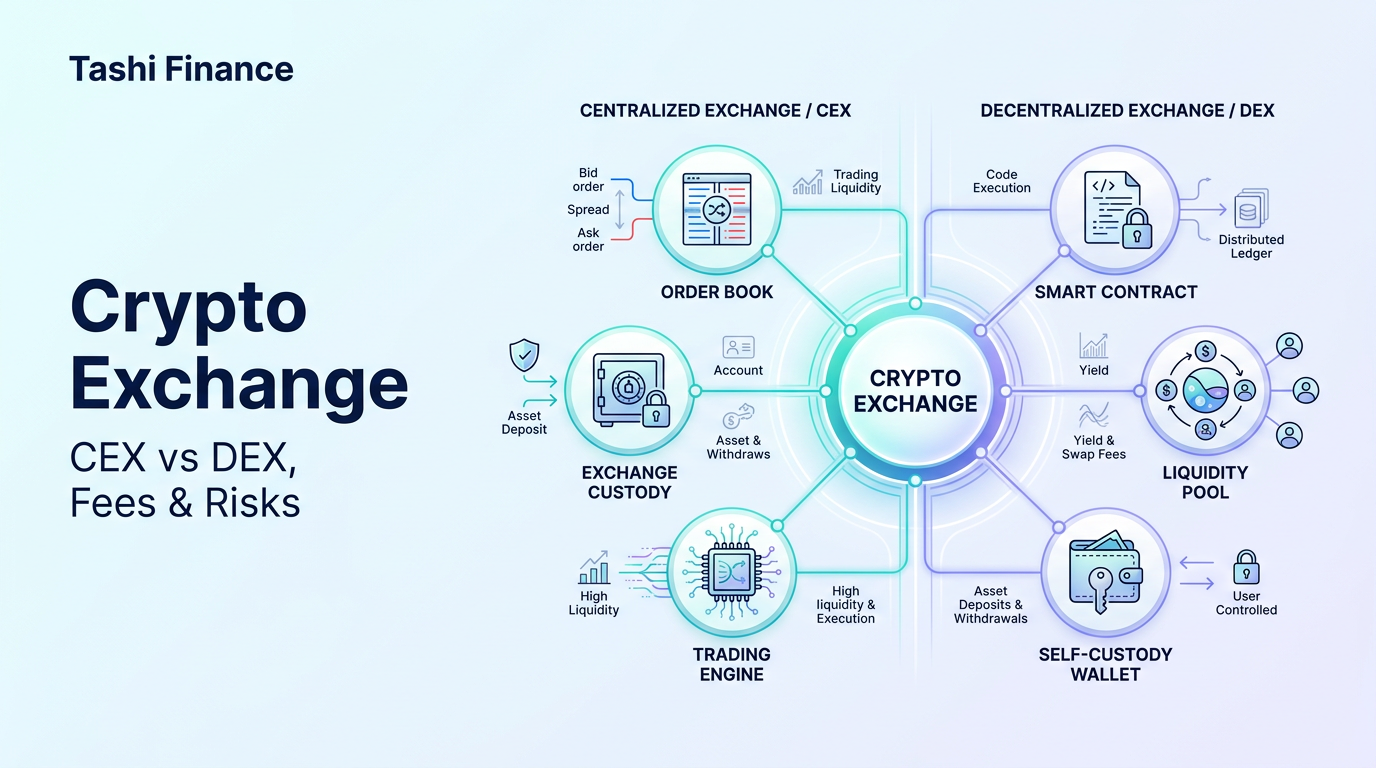
A crypto exchange is a platform or blockchain-based protocol that allows users to buy, sell, or exchange cryptocurrencies and other digital assets. Centralized exchanges typically manage accounts, custody, and order matching, while decentralized exchanges allow users to trade through smart contracts and wallets without relying on one company to custody every transaction.
At first glance, every cryptocurrency exchange appears to perform the same basic function.
A user has one asset.
Another user has a different asset.
The exchange helps them trade.
But the infrastructure behind that transaction can differ dramatically.
One platform may:
- hold customer assets;
- maintain an internal account ledger;
- operate a centralized matching engine.
Another may:
- connect directly to user wallets;
- execute trades through smart contracts;
- use liquidity pools instead of a traditional order book.
Both may be called crypto exchanges.
Their risks, custody models, pricing mechanisms, and failure points are not the same.
Understanding those differences is more important than simply comparing which platform displays the lowest trading fee.
What Is a Crypto Exchange?
A crypto exchange is a marketplace where participants can buy, sell, or exchange cryptocurrencies and other digital assets.
Depending on the platform, users may trade:
- cryptocurrency for traditional currency;
- one cryptocurrency for another;
- stablecoins;
- other supported digital assets.
A cryptocurrency exchange may also provide services beyond basic trading.
These can include:
- custody;
- deposits and withdrawals;
- advanced order types;
- market data;
- recurring purchases;
- institutional trading tools.
However, not every exchange provides the same functions.
The first important distinction is between a centralized exchange, commonly called a CEX, and a decentralized exchange, commonly called a DEX.
How Does a Crypto Exchange Work?
The process depends on the exchange model.
A simplified centralized exchange flow might look like this:
- A user creates an account.
- The user deposits money or cryptocurrency.
- The exchange credits the user’s account.
- The user submits a buy or sell order.
- The exchange matches the order with available liquidity.
- The trade is recorded in the platform’s internal system.
- The user later withdraws assets if desired.
A decentralized exchange works differently.
A typical DEX interaction may involve:
- Connecting a blockchain wallet.
- Selecting the assets to exchange.
- Reviewing the quoted transaction.
- Approving the transaction through the wallet.
- Executing the trade through smart contracts.
- Receiving the resulting asset in the user’s wallet.
The economic goal may be similar.
The infrastructure is not.
What Is a Centralized Crypto Exchange?
A centralized crypto exchange is operated by a company or centralized organization.
Users typically create accounts and interact with the platform through:
- a website;
- a mobile application;
- an API.
The exchange may control important parts of the trading environment, including:
- customer accounts;
- custody systems;
- order matching;
- deposits and withdrawals;
- trading rules.
This creates a relatively familiar user experience.
A centralized exchange can resemble a traditional online trading platform, although the assets and market infrastructure differ.
What Is CEX in Crypto?
CEX crypto refers to centralized cryptocurrency exchanges.
The abbreviation CEX stands for centralized exchange.
When a user deposits cryptocurrency into a CEX, the platform may take custody of the deposited assets while crediting the user’s account balance internally.
The user then trades using the exchange’s infrastructure.
This introduces an important distinction:
The balance displayed inside a centralized exchange account and the assets directly controlled through a personal blockchain wallet are not the same custody arrangement.
The user may have an economic claim to the exchange balance.
But the platform controls the infrastructure required to process withdrawals.
This creates counterparty risk that does not exist in exactly the same form with direct self-custody.
How a Centralized Exchange Matches Trades
Many centralized exchanges use an order book.
An order book records interest from buyers and sellers at different prices.
For example:
Buyers
- Buy at $99
- Buy at $98
- Buy at $97
Sellers
- Sell at $100
- Sell at $101
- Sell at $102
When a compatible buyer and seller meet, a trade can occur.
The exchange operates the matching system responsible for connecting orders.
Market Orders
A market order attempts to trade immediately at the best available prices.
Limit Orders
A limit order allows the trader to define an acceptable price.
It may remain unfilled if the market never reaches that price.
The exchange therefore provides more than a place to display prices.
It operates infrastructure for:
- receiving orders;
- prioritizing orders;
- matching transactions;
- updating balances.
Centralized Exchange Trades Do Not Necessarily Happen Directly on the Blockchain
This is one of the most important concepts to understand.
Suppose two customers trade Bitcoin on a centralized exchange.
The exchange does not necessarily need to send a blockchain transaction every time the two users trade.
Instead, the platform may update its own internal ledger.
For example:
Before trade
User A:
- Bitcoin: 1
- Stablecoin: 0
User B:
- Bitcoin: 0
- Stablecoin: 100,000
After trade
The platform updates the balances internally.
A blockchain transaction may become necessary when assets enter or leave the exchange.
This means:
Trading cryptocurrency on a centralized exchange is not the same as recording every individual trade directly on the underlying blockchain.
The exchange’s matching engine and the blockchain serve different functions.
What Is a Decentralized Exchange?
A decentralized exchange is a blockchain-based trading system that uses smart contracts to enable transactions between digital assets.
Users generally interact with a DEX through a compatible cryptocurrency wallet.
Instead of depositing assets into a conventional exchange account, users may keep control of their wallet until a trade is executed.
Decentralized exchanges are one of the important applications within decentralized finance.
A DEX may use:
- an order book;
- liquidity pools;
- automated market-making mechanisms.
The exact structure varies by protocol.
What Is DEX in Crypto?
DEX crypto refers to decentralized cryptocurrency exchanges.
The abbreviation DEX stands for decentralized exchange.
A DEX typically allows a user to connect a wallet and interact directly with smart contracts.
The user may not need to create a conventional exchange account before using the protocol.
This changes the custody model.
Instead of giving an exchange continuous custody of all deposited funds, the user can authorize specific blockchain transactions from their own wallet.
However, self-custody creates different responsibilities.
The user may be responsible for:
- protecting private keys;
- verifying wallet transactions;
- selecting the correct network;
- interacting with the correct smart contract.
Removing one type of intermediary does not remove every form of risk.
How Decentralized Exchanges Work
Some DEXs use order books.
Others use automated market makers, commonly called AMMs.
An AMM allows trading against assets deposited into liquidity pools.
Instead of requiring a specific buyer and seller to submit matching orders, the protocol uses a pool of assets available for exchange.
A simplified structure might be:
Trader → Smart Contract → Liquidity Pool
The trader provides one asset.
The pool provides another.
The protocol determines the exchange rate according to its pricing mechanism and available liquidity.
Order Book vs Liquidity Pool
| Order Book | Liquidity Pool |
|---|---|
| Matches buy and sell orders | Traders interact with pooled assets |
| Common on centralized exchanges | Common on decentralized exchanges |
| Price reflects available orders | Price follows protocol mechanism and pool state |
| Market makers place orders | Liquidity providers deposit assets |
| Large orders can consume price levels | Large trades can significantly change pool price |
Neither structure eliminates slippage.
The cause and mechanics of slippage can simply be different.
What Is a Liquidity Provider?
A liquidity provider deposits assets into a liquidity pool.
Those assets can then be used by other participants who want to trade.
Depending on the protocol, liquidity providers may receive:
- trading fees;
- protocol incentives.
Providing liquidity can generate returns.
It can also introduce risks involving:
- asset prices;
- smart contracts;
- liquidity;
- pool structure.
The presence of a yield does not mean the capital is risk-free.
CEX vs DEX
The CEX vs DEX comparison is one of the most important distinctions in cryptocurrency trading.
| Factor | CEX | DEX |
|---|---|---|
| Control | Operated by centralized company | Operates through blockchain protocols |
| Account | Usually required | Often wallet-based |
| Custody | Platform may hold customer assets | Users often retain wallet control |
| Trading engine | Centralized matching infrastructure | Smart contracts |
| Liquidity | Centralized platform liquidity | Protocol or pool liquidity |
| Recovery | Platform may offer account support | Blockchain transactions may be difficult to reverse |
| Main risk | Counterparty and custody risk | Smart contract and self-custody risk |
Neither model is automatically superior.
Each shifts responsibility and risk to different parts of the system.
DEX vs CEX: Where Does Trust Move?
A centralized exchange requires users to trust the company operating the platform.
That trust may involve:
- custody;
- withdrawals;
- internal accounting;
- operational security.
A decentralized exchange reduces some of this dependence on a single company.
But the user may instead need to trust:
- smart contract code;
- blockchain infrastructure;
- wallet software;
- liquidity mechanisms.
This creates a useful principle:
Moving from CEX to DEX does not eliminate trust and dependency. It changes where those dependencies exist.
Crypto Exchange vs Blockchain
A cryptocurrency exchange and a blockchain are not the same thing.
A blockchain provides infrastructure for recording and validating transactions involving supported digital assets.
An exchange provides a market for trading those assets.
For example, an exchange can experience:
- a server outage;
- withdrawal delays;
- internal account problems;
while the underlying blockchain continues operating normally.
Likewise, a blockchain network can experience congestion while the exchange’s internal trading engine continues matching trades.
These systems are connected but separate.
Deposits and Withdrawals
Deposits and withdrawals connect exchange infrastructure with blockchain networks.
Deposit
A user sends cryptocurrency to an exchange-controlled blockchain address.
After the transaction receives the required processing or confirmations, the exchange credits the user’s account.
Withdrawal
The user requests that the exchange send cryptocurrency to an external wallet.
The exchange then processes the transaction.
The difference matters because:
Deposit processing
and
exchange trading
and
blockchain settlement
can involve separate systems.
A problem in one does not automatically mean all three are failing.
Why a Withdrawal Delay Does Not Always Mean the Blockchain Is Down
Suppose a user cannot withdraw cryptocurrency from an exchange.
Several different causes are possible.
The exchange may be:
- performing wallet maintenance;
- reviewing the withdrawal;
- experiencing operational problems;
- temporarily limiting withdrawals.
The blockchain itself may still be operating normally.
Conversely, blockchain congestion can delay transactions even when the exchange is functioning correctly.
Diagnosing the problem requires identifying the layer where the failure occurred.
Crypto Exchange Fees
Crypto exchanges can charge several types of fees.
Trading Fees
A fee charged when executing trades.
Maker and Taker Fees
Some order-book exchanges distinguish between orders that add liquidity and orders that remove it.
Deposit Fees
Some payment methods may involve deposit costs.
Withdrawal Fees
Users may pay fees when transferring assets away from the platform.
Network Fees
Blockchain transactions can require network fees.
Conversion Costs
Trading between currencies or assets can involve spreads or conversion charges.
The advertised trading fee is therefore only one part of the total cost.
The Lowest Trading Fee Is Not Always the Lowest-Cost Exchange
Consider two exchanges.
Exchange A charges a very low headline trading fee.
But it may also have:
- wide spreads;
- expensive withdrawals;
- poor liquidity.
Exchange B charges a slightly higher trading fee but provides deeper liquidity and tighter spreads.
A trader may receive better overall execution on Exchange B.
The real cost can include:
Trading Fee + Spread + Slippage + Withdrawal Cost
This is why searching only for a crypto exchange with the lowest fees can produce an incomplete comparison.
What Is the Spread?
The spread is the difference between available buying and selling prices.
Suppose the best buyer offers:
$99
and the best seller asks:
$100
The spread is:
$1
A narrow spread generally indicates a more efficient and liquid market than a very wide spread.
But the spread can change quickly.
What Is Slippage?
Slippage occurs when the actual execution price differs from the price a trader expected.
Imagine an asset displayed near $100.
A trader submits a large market order.
Only a small amount is available at $100.
The rest of the order executes at:
- $100.20;
- $100.50;
- $101.
The average execution price becomes higher.
This is why the visible market price alone does not tell a trader how much a large transaction will actually cost.
Crypto Exchange Liquidity
Liquidity describes how easily an asset can be traded without causing a significant price movement.
Liquidity is one of the most important features of the broader crypto market.
A highly liquid exchange may offer:
- tighter spreads;
- deeper order books;
- lower slippage.
A poorly liquid market may have:
- wider spreads;
- larger price gaps;
- more volatile execution.
The same cryptocurrency can therefore provide a different trading experience on different exchanges.
Why Crypto Prices Can Differ Between Exchanges
There is no single centralized global cryptocurrency exchange.
Different platforms maintain separate markets.
Prices can temporarily differ because of:
- liquidity;
- supply and demand;
- geographic access;
- trading activity;
- deposit and withdrawal conditions.
Arbitrage traders may attempt to profit from price differences.
Their activity can help bring prices closer together.
But temporary differences can still exist.
The Price You See Is Not Always the Price You Can Trade
An exchange may display a last traded price.
That price represents a recent transaction.
It does not guarantee that a trader can buy or sell an unlimited amount at exactly that price.
The executable price depends on available liquidity.
This distinction becomes especially important for:
- large trades;
- smaller assets;
- volatile markets.
The quoted price is therefore a reference point.
The order book or liquidity pool determines actual execution.
Crypto Exchange Custody
Custody refers to how digital assets are held and controlled.
On a centralized exchange, the platform may control the private keys associated with customer assets.
The user’s access depends on the exchange account.
With self-custody, the user controls the wallet credentials directly.
These models create different risks.
| Exchange Custody | Self-Custody |
|---|---|
| Exchange manages key security | User manages keys |
| Account recovery may be possible | Lost keys can be difficult or impossible to recover |
| Counterparty dependence | Greater personal responsibility |
| Platform processes withdrawals | User directly authorizes transactions |
Neither model removes security risk.
It changes who is responsible for managing it.
Crypto Exchange Security Risks
Centralized exchanges can face risks involving:
Cybersecurity
Attackers may target platform infrastructure or customer accounts.
Account Takeover
A user’s exchange credentials can be compromised.
Custody
Assets held by the exchange depend on its custody systems.
Operational Failure
Technical or internal problems can disrupt trading or withdrawals.
Counterparty Risk
Users depend on the exchange meeting its obligations.
These risks are separate from the risk of the cryptocurrency itself losing market value.
Counterparty Risk
Counterparty risk is the possibility that an organization holding or managing assets fails to meet its obligations.
With a centralized cryptocurrency exchange, users may depend on the platform for:
- custody;
- withdrawals;
- accurate balances;
- operational continuity.
An exchange can offer excellent trading technology while still presenting counterparty risk.
This is why evaluating an exchange requires looking beyond the trading interface.
What Does Proof of Reserves Show?
Proof of reserves generally refers to methods intended to demonstrate that a crypto platform controls certain reserve assets.
This can provide useful information.
But proof of assets alone does not necessarily reveal the complete financial position of a company.
Other questions remain:
- What liabilities exist?
- Are assets pledged elsewhere?
- Who controls the assets?
- What obligations does the company have?
A reserve snapshot therefore should not automatically be interpreted as a complete financial audit.
The useful principle is:
Evidence that assets exist is valuable, but asset evidence alone does not necessarily show the full balance sheet.
Decentralized Exchange Risks
A decentralized exchange avoids some centralized custody risks.
But it introduces others.
Smart Contract Risk
Software weaknesses can affect funds.
Liquidity Risk
Some trading pools may have limited liquidity.
Token Risk
The assets being traded may themselves be risky.
Wallet Risk
Users are responsible for securing their wallets.
Transaction Risk
Blockchain transactions can be difficult to reverse.
Interface Risk
Users may accidentally interact with fraudulent websites or contracts.
A DEX therefore shifts more operational responsibility toward the user.
Stablecoins on Crypto Exchanges
Stablecoins are frequently used as trading and settlement assets within cryptocurrency markets.
A trader might exchange:
Cryptocurrency A → Stablecoin
and later:
Stablecoin → Cryptocurrency B
This can reduce the need to move traditional currency between every trade.
But using a stablecoin introduces another dependency.
The trader now depends not only on:
- the exchange;
- the traded cryptocurrency;
but also on the stablecoin maintaining its intended structure and value.
This is an example of how multiple layers of risk can overlap.
Cryptocurrency Exchange Platform vs Exchange Operator
The visible cryptocurrency exchange platform is not necessarily the entire business infrastructure.
A single exchange service may rely on:
- trading software;
- custody providers;
- banking partners;
- blockchain nodes;
- market makers.
The user sees one interface.
Behind it may be several independent systems.
This matters when diagnosing failures.
A problem can originate outside the main exchange application while still affecting customers.
Common Crypto Exchange Mistakes
Choosing Only by Trading Fees
Execution quality and withdrawal costs can matter just as much.
Ignoring Liquidity
Low liquidity can create large slippage.
Keeping Every Asset on One Platform
This can concentrate counterparty exposure.
Confusing Exchange Failure With Blockchain Failure
They are separate infrastructure layers.
Ignoring Withdrawal Conditions
Being able to buy an asset does not automatically guarantee that every withdrawal option is always available.
Assuming DEX Means Risk-Free
Removing centralized custody introduces smart contract and self-custody risks.
Trading Without Testing Withdrawals
Operational access matters alongside the ability to trade.
How to Evaluate a Crypto Exchange
A useful evaluation framework includes several questions.
1. What Type of Exchange Is It?
Determine whether it is centralized or decentralized.
2. Who Controls the Assets?
Understand the custody model.
3. How Much Liquidity Exists?
Look beyond trading volume headlines and consider actual market depth.
4. What Are the Total Costs?
Consider fees, spreads, slippage, and withdrawals.
5. How Are Deposits and Withdrawals Managed?
Trading is only useful if assets can move as expected.
6. What Security Model Is Used?
Understand the protections relevant to the platform type.
7. What Happens if Something Fails?
Consider account recovery, operational support, and protocol dependencies.
Crypto Exchange Evaluation Framework
| Question | Why It Matters |
|---|---|
| Is it CEX or DEX? | Defines the basic infrastructure |
| Who controls custody? | Identifies asset-control risk |
| How deep is liquidity? | Affects spreads and slippage |
| What is the total trading cost? | Reveals real execution expense |
| Are withdrawals reliable? | Determines asset mobility |
| What security risks exist? | Helps evaluate operational exposure |
| What assets are supported? | Determines market access |
| What other systems are required? | Reveals hidden dependencies |
This approach is more useful than simply searching for the best crypto exchange.
The best choice depends on what the user is actually trying to do.
CEX vs DEX: Which Is Better?
There is no universal answer.
A centralized exchange may be more suitable for someone who values:
- familiar account management;
- customer support;
- conventional order books;
- easier connections to traditional payment methods.
A decentralized exchange may appeal more to someone who values:
- wallet-based interaction;
- direct access to blockchain protocols;
- greater control over asset custody.
The tradeoff is between different types of control, convenience, and risk.
The correct question is not:
Is CEX or DEX always better?
A better question is:
Which exchange structure matches the user’s trading needs, custody preferences, technical ability, and risk tolerance?
Frequently Asked Questions
What is a crypto exchange?
A crypto exchange is a platform or blockchain protocol that allows users to buy, sell, or exchange cryptocurrencies and other digital assets.
What is a cryptocurrency exchange?
A cryptocurrency exchange is another term for a trading platform that provides markets for cryptocurrencies and related digital assets.
What is CEX in crypto?
CEX means centralized exchange. It is a cryptocurrency exchange operated by a centralized company that typically manages accounts, trading infrastructure, and often customer custody.
What is DEX in crypto?
DEX means decentralized exchange. It is a blockchain-based trading system that allows users to exchange digital assets through smart contracts.
What is the difference between CEX and DEX?
A CEX is operated by a centralized organization and may hold user assets. A DEX uses blockchain protocols and typically allows users to interact through their own wallets.
How does a centralized crypto exchange work?
Users deposit assets, submit trading orders, and trade through the exchange’s internal matching infrastructure. Blockchain transactions are generally required for deposits and withdrawals rather than every internal trade.
How does a decentralized crypto exchange work?
Users connect blockchain wallets and trade through smart contracts. Depending on the protocol, trades may use order books or liquidity pools.
What are crypto exchange fees?
Costs can include trading fees, spreads, slippage, deposit charges, withdrawal fees, and blockchain network fees.
Are decentralized exchanges safer than centralized exchanges?
Not automatically. DEXs reduce some centralized custody risks but can introduce smart contract, wallet, liquidity, and transaction risks.
Why can cryptocurrency prices differ between exchanges?
Different exchanges have separate liquidity and trading activity. Temporary differences can occur when supply and demand vary between platforms.
Does every centralized exchange trade happen on the blockchain?
Not necessarily. Centralized exchanges can update customer balances through internal ledgers. Blockchain transactions are commonly used when assets are deposited or withdrawn.
What is the best crypto exchange?
There is no single best exchange for every user. The appropriate choice depends on liquidity, custody, fees, supported assets, security, withdrawals, geography, and trading requirements.
Final Takeaway
A crypto exchange provides infrastructure for buying, selling, and exchanging digital assets.
But the term covers two significantly different models.
Centralized exchanges provide managed platforms with accounts, custody systems, and centralized trading infrastructure.
Decentralized exchanges use smart contracts and blockchain wallets to provide markets without relying on the same type of centralized custody.
Neither model eliminates risk.
They distribute risk differently.
A CEX user may depend more heavily on the exchange operator.
A DEX user may depend more heavily on:
- smart contracts;
- wallet security;
- blockchain transactions;
- protocol liquidity.
The most important insight is that a crypto exchange is also separate from the underlying blockchain.
Trading, custody, deposits, withdrawals, and blockchain settlement can all occur at different infrastructure layers.
Understanding those layers makes it easier to evaluate both costs and risk.
The better question is therefore not simply:
Which crypto exchange has the lowest fees?
It is:
Which exchange provides the right combination of liquidity, custody, security, execution quality, and asset access for the way I intend to use it?
