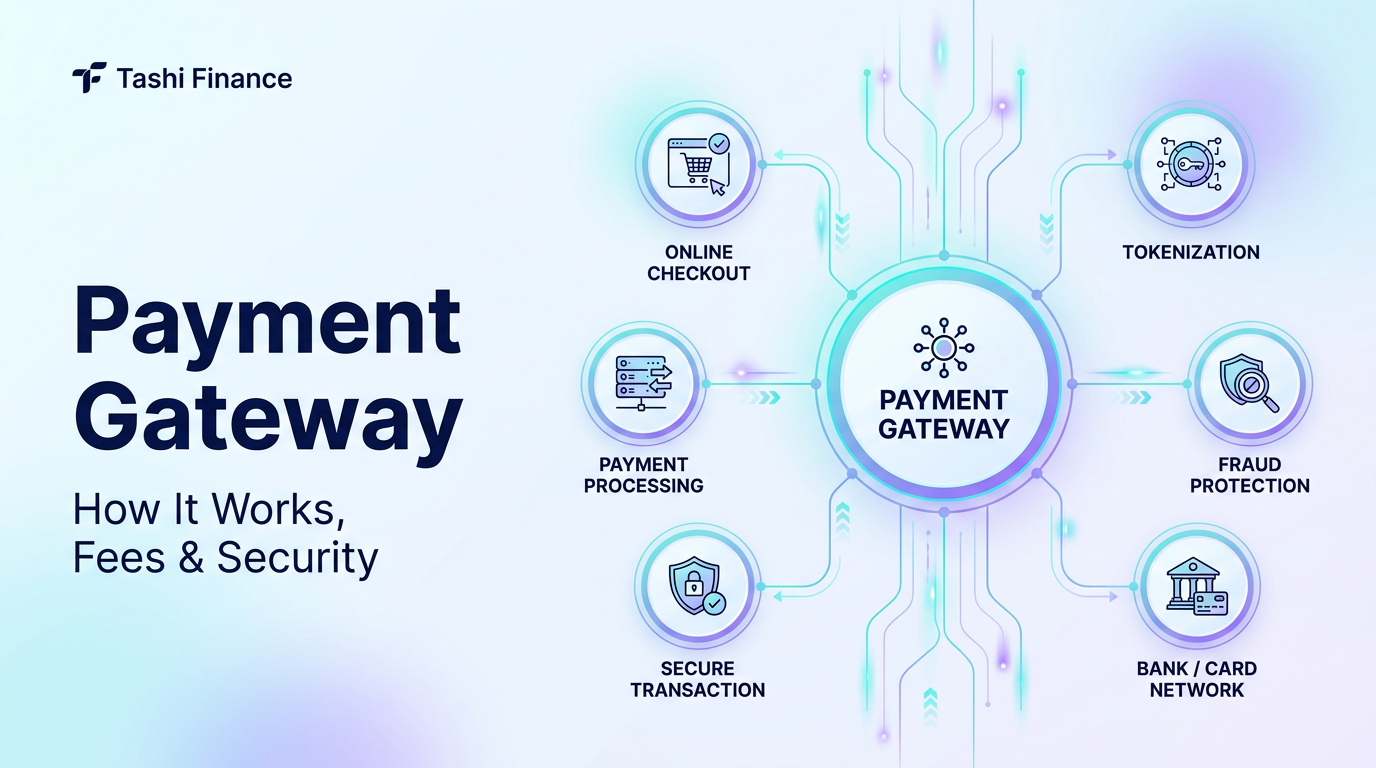
What Is a Payment Gateway? How It Works, Fees, Security, and Integration
A payment gateway is technology that securely transfers payment information between a customer, merchant, and the financial systems involved in authorizing a transaction. In online commerce, the gateway helps collect and transmit payment data, apply security controls, and return an approval or decline response so the merchant can complete the checkout process.
For a customer, an online payment may appear to take only a few seconds.
Enter payment details.
Press a button.
Receive confirmation.
Behind that simple experience, however, several systems may be communicating with one another.
The payment gateway is one part of that process.
It does not necessarily hold the customer’s money, issue the payment card, or perform final settlement.
Its main role is to help payment information move securely between the checkout and the financial infrastructure responsible for processing the transaction.
Understanding this distinction is important because the terms gateway, processor, acquirer, and payment provider are often used as if they mean the same thing.
They do not.
What Is a Payment Gateway?
A payment gateway is a technology layer that helps transmit transaction information from a merchant’s checkout environment to the systems involved in payment authorization.
It is commonly used in:
- ecommerce websites;
- mobile applications;
- subscription services;
- online marketplaces;
- digital platforms;
- other remote payment environments.
When a customer submits payment information, the gateway may help:
- capture the payment request;
- protect sensitive information;
- send transaction data to the appropriate processing infrastructure;
- receive the authorization response;
- return the result to the merchant.
The exact architecture depends on the provider and payment method.
But the gateway’s central purpose is connectivity.
It connects the payment experience used by the customer with the systems that determine whether the transaction can proceed.
Payment Gateway Meaning
The simplest payment gateway meaning is:
A payment gateway is the secure digital bridge between a merchant’s checkout and the payment processing infrastructure.
The word gateway is useful because the system acts as an entry point.
A customer’s payment information enters through the checkout.
The gateway helps route the transaction toward the relevant financial systems.
The response then travels back toward the merchant.
However, calling it a bridge does not mean that every gateway performs exactly the same functions.
Modern providers may combine gateway technology with:
- payment processing;
- fraud detection;
- tokenization;
- recurring billing;
- reporting;
- settlement tools.
These integrated platforms are also part of the broader financial technology ecosystem that connects software with financial services.
This creates one of the biggest sources of confusion in online payments.
A company may sell an all-in-one payment product while internally operating several separate payment functions.
How Payment Gateway Works
A typical online card transaction can be simplified into several stages.
1. Customer Starts the Payment
The customer enters payment details or selects a saved payment method.
2. Payment Information Is Protected
Sensitive data may be encrypted, tokenized, or handled through a secure hosted payment interface.
3. Gateway Sends the Payment Request
The online payment gateway forwards the transaction information into the payment processing chain.
4. Authorization Is Requested
The relevant payment systems determine whether the transaction can be approved.
5. Approval or Decline Is Returned
The response travels back through the payment infrastructure.
6. Merchant Receives the Result
The merchant’s website or application receives the response and shows the customer the outcome.
A successful authorization does not necessarily mean the merchant has already received the final funds.
That usually happens later through clearing and settlement processes.
Simplified Payment Gateway Flow
| Stage | Main Action | Typical Result |
|---|---|---|
| Checkout | Customer submits payment | Payment request created |
| Security | Data is protected | Sensitive information secured |
| Gateway | Transaction is transmitted | Request enters processing chain |
| Authorization | Payment is evaluated | Approved or declined |
| Response | Result returns to merchant | Checkout updated |
| Settlement | Funds are transferred later | Merchant receives funds |
This distinction between authorization and settlement is important.
A payment can be approved at checkout but still encounter problems later.
Payment Gateway vs Payment Processor
A payment gateway and a payment processor are related, but they perform different roles.
The gateway primarily helps collect and transmit transaction information.
The processor handles more of the communication required to process the payment through financial networks.
| Payment Gateway | Payment Processor |
|---|---|
| Connects checkout to payment infrastructure | Processes transaction messages |
| Focuses heavily on secure payment data transmission | Connects financial participants |
| Commonly associated with online checkout | Used across online and other payment channels |
| Returns transaction responses | Helps route authorization and settlement information |
| May be bundled with other services | May operate behind a gateway product |
In practice, merchants often buy both capabilities from one provider.
That does not make the two functions identical.
A useful way to think about the relationship is:
The gateway handles the entrance to the payment flow. The processor helps move the transaction through the financial processing system.
Payment Gateway vs Acquiring Bank
The acquiring side of a card payment is also different from the gateway.
An acquiring bank or acquiring institution provides the merchant-side relationship that allows card payments to be accepted and settled.
A simplified structure may look like this:
Customer → Payment Gateway → Processor → Card Network → Issuing Bank
and later:
Issuing side → Network → Acquiring side → Merchant
Real payment architectures can be more complex, especially when multiple service providers are involved.
The important lesson is that the gateway is only one layer.
What Is a Payment Gateway System?
A payment gateway system usually includes more than a simple transaction connection.
Depending on the provider, the system may include:
- checkout forms;
- APIs;
- encryption;
- tokenization;
- fraud screening;
- transaction routing;
- authentication tools;
- reporting;
- refund functions;
- recurring payment support.
This is why two gateways can behave differently even when they both support the same payment methods.
One provider may focus on basic payment transmission.
Another may offer a broader payment platform.
Businesses should therefore compare functions rather than relying only on the label “payment gateway.”
Online Payment Gateway
An online payment gateway is specifically designed to support remote digital transactions.
Unlike an in-person payment terminal, the customer and merchant may not be physically present in the same location.
This creates additional challenges.
The merchant cannot physically inspect the payment instrument.
The payment environment may therefore depend more heavily on:
- authentication;
- fraud detection;
- device signals;
- secure data transmission;
- transaction monitoring.
An online payment gateway is consequently both a connectivity tool and part of the merchant’s broader payment security architecture.
Digital Payment Gateway
The phrase digital payment gateway can be used more broadly than card payments.
A modern gateway may support several payment methods, such as:
- payment cards;
- bank payments;
- digital wallets;
- local payment methods;
- other supported digital payment options.
The gateway may present these methods through one integration.
This can simplify the merchant’s technical architecture.
However, supporting multiple payment methods does not mean every payment follows the same processing path.
A card payment and a bank account payment may use completely different underlying infrastructure.
The gateway acts as a common interface while the actual payment rails remain different.
Payment Gateway Services
Typical payment gateway services can include several functions.
Payment Data Collection
The gateway provides a method for collecting payment information.
Secure Transmission
Payment data is transmitted to the required processing systems.
Authorization Messaging
The gateway helps send and receive payment authorization requests.
Tokenization
Sensitive payment information may be replaced with a token.
Fraud Screening
Some providers analyze transactions for suspicious behavior.
Recurring Payments
Stored payment credentials can support subscription billing.
Reporting
Businesses can review transaction activity through dashboards or APIs.
Refund Management
Merchants may initiate refunds through the payment platform.
Not every provider offers every function.
The merchant should understand which services are included and which require separate products.
What Is a Payment Gateway Provider?
A payment gateway provider operates technology that allows businesses to connect their checkout systems to payment processing infrastructure.
Some providers specialize primarily in gateway technology.
Others offer broader packages that may include:
- gateway;
- processing;
- merchant accounts;
- fraud tools;
- payment methods;
- reporting;
- settlement services.
This can make provider comparisons difficult.
A lower gateway fee may not represent a lower total payment cost if additional services are charged separately.
Businesses should therefore compare the full payment stack.
The Hidden Complexity of an “All-in-One” Payment Provider
An all-in-one payment product can make integration easier.
But internally, several different systems may still exist.
For example:
Checkout → Gateway → Fraud Engine → Processor → Network → Bank
The merchant may interact with only one company.
The transaction itself may still depend on multiple technical and financial layers.
This matters when something fails.
A merchant may see an error from its payment provider even though the actual problem occurred:
- at the gateway;
- inside the processor;
- at the card network;
- at the issuing bank.
The company selling the service is not always the system causing the failure.
Secure Payment Gateway
A secure payment gateway should protect payment information during collection, transmission, and processing.
Security can involve several layers.
Encryption
Sensitive information is protected during transmission.
Tokenization
Payment information can be replaced with a non-sensitive token.
Authentication
Additional verification can help confirm that a transaction is legitimate.
Fraud Detection
Transaction behavior may be analyzed for suspicious patterns.
Access Controls
Only authorized systems and users should access sensitive payment functions.
Security Standards
Payment providers and merchants may need to meet applicable industry and regulatory requirements.
Security is not one feature.
It is a combination of technologies, processes, controls, and responsibilities.
Tokenization vs Encryption
Tokenization and encryption are often confused.
They solve related but different problems.
Encryption
Encryption transforms information into an unreadable format that can be restored using the appropriate cryptographic process.
Tokenization
Tokenization replaces sensitive information with another value that has limited usefulness outside the intended system.
For example, a merchant may store a token representing a customer’s card rather than storing the full card number.
This can reduce exposure of sensitive payment data.
However, tokenization does not automatically make the entire payment environment secure.
Attackers may target:
- merchant accounts;
- customer authentication;
- administrative access;
- refund systems;
- account recovery.
Protecting payment data is only one part of payment security.
The Gateway Security Misconception
One common mistake is assuming that using a secure gateway automatically makes the merchant’s entire checkout secure.
A gateway can protect payment transmission.
But the merchant’s website may still have problems involving:
- compromised administrator accounts;
- malicious scripts;
- insecure plugins;
- account takeover;
- fraudulent orders.
Security therefore follows a shared-responsibility model.
The gateway protects parts of the payment flow.
The merchant still needs to protect the surrounding environment.
Payment Gateway Fees
Payment gateway fees vary depending on the provider and business model.
Common cost components may include:
- setup fees;
- monthly fees;
- per-transaction gateway fees;
- processing fees;
- currency conversion fees;
- cross-border fees;
- chargeback fees;
- refund fees;
- optional fraud tool fees.
Not every provider charges every type of fee.
Some combine gateway and processing costs into one transaction price.
Others separate them.
Why the Lowest Transaction Fee May Not Be the Cheapest Option
Suppose Provider A has a lower per-transaction fee.
But Provider A also charges for:
- monthly access;
- fraud tools;
- international payments;
- additional payment methods.
Provider B may have a higher headline transaction rate but include more services.
Therefore, businesses should compare:
Total Payment Cost = Transaction Costs + Fixed Fees + Additional Service Costs + Operational Costs
The cheapest advertised price is not always the lowest total cost.
Payment Gateway Integration
Payment gateway integration connects the merchant’s website, application, or checkout process to the gateway.
There are several common approaches.
Hosted Checkout
The customer is redirected to or shown a payment interface hosted by the provider.
This can reduce some of the merchant’s technical responsibility.
Embedded Payment Form
The payment experience appears within the merchant’s website while using provider-controlled components.
API Integration
The merchant builds a more customized payment experience using APIs.
Plugin or Platform Integration
Ecommerce platforms may connect to gateways through ready-made plugins or extensions.
Each method involves different tradeoffs between:
- control;
- customization;
- development effort;
- security responsibility;
- maintenance.
Hosted vs API Payment Gateway Integration
| Hosted Integration | Direct API Integration |
|---|---|
| Faster to deploy | More customization |
| Lower development effort | Higher development effort |
| Provider controls more of checkout | Merchant controls more of experience |
| Less flexibility | Greater flexibility |
| Often easier for smaller businesses | Better for complex payment products |
There is no universally best approach.
A small ecommerce business may value simplicity.
A large platform may need deeper control over checkout and transaction routing.
Payment Gateway Integration Cost
The real payment gateway integration cost is broader than the provider’s setup fee.
Businesses should consider:
- developer time;
- testing;
- security work;
- ecommerce plugins;
- recurring maintenance;
- API updates;
- monitoring;
- troubleshooting.
A gateway with no setup charge can still be expensive to integrate if the technical implementation is complex.
Likewise, a provider with a paid integration package may reduce internal development work.
The correct comparison is the total implementation cost.
Requirements for Payment Gateway Integration
Before integrating a gateway, a business may need several things.
Business Account Setup
The provider may require business verification.
Payment Processing Relationship
The merchant needs access to the required processing infrastructure.
Technical Environment
The website or application must support the chosen integration.
Security Controls
Payment data must be handled appropriately.
Testing
The integration should be tested before live transactions begin.
Operational Processes
The business should define how it handles:
- failed payments;
- refunds;
- disputes;
- chargebacks;
- suspicious transactions.
Integration is therefore not finished when the first successful test payment appears.
The business also needs processes for everything that happens after checkout.
Why a Payment Can Fail Even When the Gateway Works
This is one of the most important operational points.
A declined transaction does not automatically mean the gateway failed.
A payment may fail because of:
- incorrect payment information;
- insufficient funds;
- issuer decline;
- authentication failure;
- fraud screening;
- technical timeout;
- network interruption.
The gateway can operate correctly while returning a decline.
This creates an important distinction:
A failed payment is not always a failed payment gateway.
Businesses should therefore separate:
technical errors
from
legitimate payment declines.
The recovery strategy is different for each.
The Timeout Problem
Payment systems involve several connected services.
Sometimes one system sends a request but does not receive a response quickly enough.
The merchant may see a timeout.
But the transaction could still have been processed elsewhere.
This can create a difficult situation:
Merchant sees failure → Customer tries again → Original payment eventually completes → Duplicate transaction
Payment systems therefore need mechanisms for:
- transaction identifiers;
- status checks;
- duplicate prevention;
- idempotent requests.
This is an example of a failure mode that is easy to overlook when businesses focus only on successful payments.
Payment Gateway and Fraud Detection
Many gateway providers offer fraud detection tools.
These tools may examine signals such as:
- transaction value;
- customer behavior;
- device information;
- location patterns;
- payment history.
The objective is to identify suspicious transactions before they create losses.
However, fraud prevention creates a tradeoff.
Very aggressive controls may block legitimate customers.
Weak controls may allow more fraudulent activity.
The ideal goal is therefore not simply to decline as many suspicious transactions as possible.
It is to balance:
Fraud Prevention + Customer Conversion
A payment system that blocks every risky transaction may also reject valuable legitimate customers.
False Declines
A false decline occurs when a legitimate payment is rejected.
This can be costly because the business may lose:
- the transaction;
- the customer;
- future purchases.
The customer may not know why the payment failed.
They may simply leave.
This means payment optimization is not only about accepting more payment methods.
It also involves reducing unnecessary payment failures.
Payment Gateway for Small Business
A payment gateway for small business should generally prioritize simplicity and predictable operations.
Important criteria may include:
- easy integration;
- transparent pricing;
- relevant payment methods;
- reliable support;
- fraud controls;
- simple refunds;
- clear reporting.
A small business may not need the most technically advanced gateway.
Complexity can create unnecessary operational costs.
The better solution is usually the one that fits the business’s actual transaction volume, customers, and technical capabilities.
How to Choose a Payment Gateway
Businesses can evaluate a gateway using seven factors.
1. Payment Methods
Does the gateway support the methods customers actually use?
2. Geographic Coverage
Can the business accept payments in its important markets?
3. Total Cost
What is the real cost beyond the advertised transaction fee?
4. Security
What security and fraud controls are available?
5. Integration
How difficult is implementation and maintenance?
6. Reliability
What happens when the gateway or connected systems experience problems?
7. Reporting and Operations
Can the business easily manage refunds, disputes, and reconciliation?
These criteria are more useful than simply searching for the best payment gateway.
The best option depends on the business model.
Payment Gateway Decision Framework
| Question | Why It Matters |
|---|---|
| Which payment methods do customers use? | Determines required payment support |
| Where are customers located? | Affects geographic and currency needs |
| What is the total transaction cost? | Reveals real payment expense |
| How will the gateway be integrated? | Determines technical effort |
| What fraud controls are available? | Helps manage payment risk |
| How are failed payments handled? | Affects conversion |
| How reliable is the infrastructure? | Reduces payment disruption |
| How are refunds and disputes managed? | Affects operations after checkout |
A gateway should be selected as part of the entire payment strategy rather than as an isolated technology purchase.
Payment Gateway and Digital Payments
A payment gateway is one component of the broader digital payments ecosystem.
Digital payments can include:
- cards;
- bank payments;
- mobile payments;
- digital wallets;
- other electronic payment methods.
The gateway may provide one interface for several of these methods.
But each method can still have its own:
- authorization process;
- settlement process;
- fees;
- failure modes.
Understanding the gateway is therefore useful, but businesses should also understand the payment methods operating behind it.
Payment Gateway and Open Banking
Some payment providers can also connect merchants with bank-based payment methods.
These may involve open banking connections that allow customers to authorize payments from bank accounts.
The gateway or payment platform can present this option through the checkout.
However, the underlying flow differs from a card payment.
The gateway may be the common front-end integration while different financial systems handle the payment itself.
This illustrates the broader role of modern gateways:
One checkout interface can connect to multiple payment infrastructures.
Common Payment Gateway Mistakes
Choosing Based Only on Price
Low advertised fees can hide additional operational or service costs.
Adding Too Many Payment Methods
More options are not always better if customers rarely use them.
Ignoring Failure Recovery
Businesses need processes for timeouts, duplicate attempts, and payment status uncertainty.
Treating Every Decline as a Technical Problem
Many declines originate outside the gateway.
Ignoring Mobile Checkout
A technically functional payment page can still lose customers if the mobile experience is poor.
Overlooking Refunds and Reconciliation
Payment operations continue after the transaction is approved.
Frequently Asked Questions
What is a payment gateway?
A payment gateway is technology that securely transmits payment information between a merchant checkout and the financial systems involved in authorizing a transaction.
What is the payment gateway meaning?
Payment gateway means a secure connection layer that allows payment requests and responses to move between the merchant and payment processing infrastructure.
How does a payment gateway work?
A payment gateway collects or receives payment information, protects the data, sends the transaction for authorization, and returns the approval or decline result to the merchant.
Is a payment gateway the same as a payment processor?
No. A gateway primarily connects the checkout to the payment infrastructure, while a processor handles more of the transaction communication between financial systems. One provider may offer both services.
What is an online payment gateway?
An online payment gateway is a gateway designed to support remote digital transactions through websites, applications, and other online checkout environments.
What is a secure payment gateway?
A secure payment gateway uses controls such as encryption, tokenization, authentication, and access management to help protect payment information and transactions.
What are payment gateway fees?
Payment gateway fees can include transaction fees, monthly charges, setup costs, international payment fees, fraud tool costs, and other service charges depending on the provider.
What is payment gateway integration?
Payment gateway integration is the technical process of connecting a website or application checkout to a payment gateway through hosted pages, embedded components, plugins, or APIs.
Can a payment fail even if the gateway works correctly?
Yes. A payment can be declined because of insufficient funds, authentication problems, issuer decisions, fraud controls, or other reasons even when the gateway is functioning normally.
What is the best payment gateway?
There is no single best gateway for every business. The right option depends on payment methods, transaction volume, geography, fees, security requirements, integration complexity, and operational needs.
Final Takeaway
A payment gateway is an important connection point in online commerce.
It helps move payment information securely from the customer checkout into the infrastructure responsible for processing and authorizing the transaction.
But the gateway is not the entire payment system.
A successful payment may involve:
- the merchant;
- the gateway;
- the processor;
- payment networks;
- banks;
- fraud systems;
- authentication services.
Understanding these separate layers helps businesses diagnose problems more accurately.
It also makes provider selection easier.
The right payment gateway is not necessarily the one with the lowest advertised fee or the largest number of features.
It is the one that provides the right balance of:
- payment coverage;
- security;
- reliability;
- integration complexity;
- operational tools;
- total cost.
The most useful question is therefore not simply:
Which payment gateway should we use?
It is:
Which payment architecture best supports our customers, markets, technical capabilities, and payment risks?
