What Is Asset Tokenization? How It Works, RWA Examples, Benefits, and Risks
Asset tokenization is the process of creating or issuing digital tokens that represent an asset or defined rights connected to an asset on programmable digital infrastructure. A token may represent the asset itself or a legal or economic claim to it. Tokenization can change how ownership is recorded and transferred, but it does not automatically make the underlying asset liquid, safe, or legally enforceable.
The concept is often explained as putting real-world assets “on the blockchain.”
That description is convenient.
It is also incomplete.
A building does not physically move onto a blockchain.
A government bond does not become computer code simply because a token represents it.
What actually changes is the infrastructure used to record, transfer, or manage ownership and financial rights.
That creates an important distinction between four separate things:
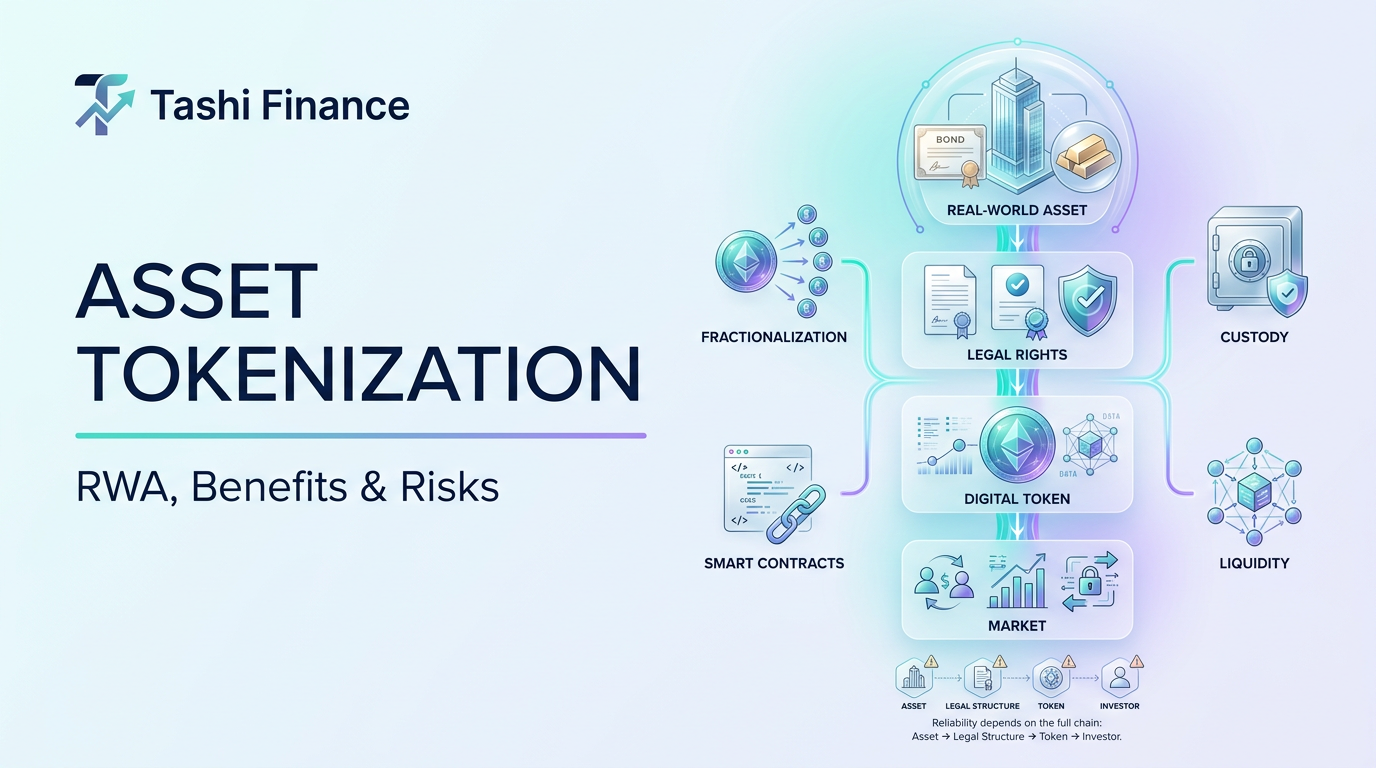
The underlying asset → The legal rights → The digital token → The market where the token trades
Understanding those four layers is essential.
A token can function perfectly at the technology layer while problems still exist with the asset, issuer, custodian, legal structure, or secondary market.
What Is Asset Tokenization?
Asset tokenization involves representing an asset or a defined economic interest through digital tokens.
The underlying subject could include:
- financial securities;
- bonds;
- investment fund interests;
- real estate interests;
- commodities;
- private credit;
- other contractual or ownership rights.
Depending on the structure, the token may represent:
- direct ownership;
- beneficial ownership;
- a contractual claim;
- entitlement to income;
- another defined economic right.
This is why the token itself does not tell an investor everything they need to know.
The legal and financial structure behind the token determines what the holder actually owns.
Financial tokenization increasingly involves programmable ledgers that can combine recordkeeping with asset transfers and automated processes, although the architecture varies significantly between projects and jurisdictions.
What Is Tokenization?
The broader search query what is tokenization has several meanings.
In data security, tokenization can mean replacing sensitive information with a non-sensitive substitute.
In finance, the meaning is different.
Financial tokenization generally refers to creating, issuing, recording, or representing assets as digital tokens on programmable infrastructure.
The two concepts should not be confused.
This article focuses exclusively on financial and investment assets.
Asset Tokenization Meaning
The practical asset tokenization meaning is easier to understand through a simple example.
Imagine a property worth $10 million.
Instead of transferring the property itself through a blockchain, a legal structure could establish defined economic rights connected to the property.
Digital tokens could then represent those rights.
The structure might look like this:
Property
↓
Legal Entity or Ownership Structure
↓
Defined Investor Rights
↓
Digital Tokens
↓
Token Holders
The blockchain records and transfers the tokens.
The legal structure connects those tokens to the economic value of the property.
This distinction is fundamental.
A blockchain can prove control of a token. It does not automatically prove direct legal ownership of whatever real-world asset the token claims to represent.
The strength of the investment therefore depends on the entire structure, not only the blockchain.
How Does Asset Tokenization Work?
The exact process varies, but a simplified tokenization project may involve several stages.
1. Identify the Asset
The issuer determines what asset or financial interest will be represented.
2. Establish Ownership
The underlying asset and its ownership must be verified.
3. Define the Legal Structure
The issuer determines what rights token holders receive.
4. Create the Tokens
Digital tokens are issued using programmable infrastructure.
5. Connect Tokens to Investor Rights
The token must be linked to the relevant legal or contractual structure.
6. Establish Custody
Arrangements may be required for both the underlying asset and the digital tokens.
7. Enable Transfers
Eligible participants may buy, sell, or transfer tokens according to applicable rules.
8. Manage the Asset
The underlying asset still requires ongoing administration.
The blockchain therefore represents only one layer of the complete system.
Asset Tokenization Process
| Layer | Main Function | Key Question |
|---|---|---|
| Underlying asset | Creates economic value | What actually generates the value? |
| Legal structure | Defines investor rights | What does the holder legally own? |
| Token | Digitally represents the rights | What exactly does the token represent? |
| Blockchain | Records and transfers tokens | How are transactions processed? |
| Custody | Protects assets and access | Who controls the assets? |
| Market | Enables buying and selling | Is meaningful liquidity available? |
This framework helps separate technological innovation from financial reality.
What Are Tokenized Assets?
Tokenized assets are assets or economic rights represented through digital tokens.
Some assets may be digitally native.
Others may exist outside the blockchain and be represented by tokens.
This creates two different models.
Native Digital Asset
The asset itself exists within digital infrastructure.
Tokenized External Asset
The token represents an asset or claim that exists through a separate legal or financial structure.
The second model creates additional dependencies.
An investor may depend on:
- the token issuer;
- the legal entity;
- the custodian;
- the asset administrator;
- the trading platform.
Tokenization can change the transaction infrastructure without eliminating those parties.
What Is Real World Asset Tokenization?
Real world asset tokenization refers to creating blockchain-based or digitally recorded tokens connected to assets or financial interests that exist outside purely native crypto markets.
These assets may include interests connected to:
- real estate;
- bonds;
- commodities;
- private credit;
- investment funds;
- other traditional financial assets.
The term is commonly shortened to RWA tokenization.
The central idea is to connect traditional economic value with programmable digital infrastructure.
But the phrase “real-world asset on blockchain” should not be interpreted too literally.
The blockchain normally contains a token and related transaction records.
The actual asset can remain in the physical or traditional financial world.
RWA Tokenization Meaning
The practical RWA tokenization meaning can be summarized as:
The creation of digital tokens designed to represent legally or economically defined rights connected to real-world assets.
Consider tokenized real estate.
The token might represent:
- shares in a company that owns the property;
- an interest in an investment vehicle;
- entitlement to a portion of income;
- another contractual claim.
These structures are economically different.
Two platforms may both advertise “tokenized real estate” while offering token holders completely different rights.
The label alone is not enough.
What Is RWA in Crypto?
RWA in crypto generally refers to real-world assets or financial claims represented through blockchain-based tokens.
This area creates a bridge between traditional finance and digital asset infrastructure.
However, RWA tokens should not automatically be evaluated in the same way as native cryptocurrencies.
A native crypto asset may derive value from:
- network usage;
- scarcity;
- market demand.
An RWA token may instead depend on:
- an external asset;
- an issuer;
- contractual rights;
- custody;
- legal enforcement.
The technology can be similar.
The underlying risk structure can be very different.
Asset Tokenization vs Traditional Digitization
Most modern financial assets are already recorded electronically.
Therefore, tokenization is not simply the difference between paper and digital records.
The potential change lies in how assets are represented and transferred.
Traditional infrastructure may use multiple separate databases operated by different intermediaries.
Tokenized infrastructure can potentially allow participants to interact through a shared programmable ledger.
This may reduce some reconciliation and operational friction, especially when issuance, trading, settlement, and servicing can be coordinated in a common digital environment.
| Traditional Digital Asset | Tokenized Asset |
|---|---|
| Recorded in conventional databases | Represented on programmable infrastructure |
| Multiple intermediaries may maintain records | Participants may share ledger infrastructure |
| Processes can require reconciliation | Some processes may be synchronized |
| Settlement occurs through existing systems | Settlement architecture may be integrated |
| Automation can exist | Smart contracts can add programmability |
Tokenization therefore represents an infrastructure change rather than simply converting a paper document into a digital file.
Asset Tokenization and Blockchain Technology
Many tokenization systems use blockchain technology or other forms of distributed ledger technology to issue and transfer tokens.
The blockchain can provide:
- transaction records;
- shared state;
- programmable execution;
- asset transfer infrastructure.
However, using blockchain does not eliminate every intermediary.
A tokenized asset may still require:
- regulated financial institutions;
- custodians;
- legal entities;
- asset managers;
- administrators.
The technology changes how those participants coordinate.
It does not necessarily make all of them unnecessary.
Smart Contracts in Asset Tokenization
A smart contract can automate certain functions associated with tokenized assets.
Depending on the structure, smart contracts may help manage:
- token issuance;
- transfers;
- ownership records;
- payment distributions;
- investor restrictions;
- other predefined actions.
For example, a tokenized bond system could potentially automate certain lifecycle processes.
But smart contracts only execute programmed rules.
They do not automatically verify that an external asset exists or that legal obligations are being honored.
This means tokenization combines two different forms of trust:
Trust in the digital infrastructure
and
trust in the off-chain legal and operational structure
Strong technology cannot compensate for a fundamentally weak ownership claim.
The Asset–Token Separation Problem
This is one of the most important risks in real-world asset tokenization.
Suppose a blockchain correctly records that:
Wallet A owns Token X
The record may be technically accurate.
But several additional questions remain:
- What does Token X legally represent?
- Who owns the underlying asset?
- Can the token holder enforce their rights?
- What happens if the issuer fails?
- What happens if the asset is sold outside the token system?
The blockchain answers the first question:
Who controls the token?
It does not automatically answer:
Who ultimately has enforceable rights to the underlying asset?
This creates a gap between digital ownership records and real-world legal enforcement.
Benefits of Asset Tokenization
Tokenization can potentially create several benefits.
Programmability
Asset rules can interact with smart contracts and automated workflows.
Improved Transfer Infrastructure
Digital tokens may simplify some processes involved in transferring assets.
Fractionalization
Economic interests can sometimes be divided into smaller units.
Shared Recordkeeping
Participants can potentially work from a common transaction record.
Automation
Some asset lifecycle processes can be automated.
Expanded Market Design
Tokenization may enable new approaches to issuance, trading, and asset servicing.
Institutional research increasingly emphasizes that some of the largest potential gains come from reducing market frictions across the asset lifecycle rather than merely creating digital versions of existing securities.
But every potential benefit depends on implementation.
Tokenization does not guarantee that these advantages will appear automatically.
The Biggest Tokenization Misconception: Fractionalization Creates Liquidity
A $10 million asset can theoretically be divided into thousands of smaller digital units.
That makes the investment easier to divide.
It does not automatically make it easier to sell.
Liquidity requires:
- willing buyers;
- willing sellers;
- market infrastructure;
- sufficient trading activity;
- reasonable transaction costs.
This leads to an important principle:
Fractionalization is a technical property. Liquidity is a market property.
The two should not be treated as interchangeable.
An illiquid asset divided into 100,000 digital tokens can still remain illiquid.
The Liquidity Illusion
A tokenized asset may appear more liquid because it can technically be transferred at any time.
But technical transferability and economic liquidity are different.
Suppose a token can move between blockchain wallets within seconds.
That does not guarantee someone is willing to buy it at a reasonable price.
A useful distinction is:
Can I transfer the token?
versus:
Can I sell the token quickly without accepting a large discount?
These are different questions.
Recent research into tokenized property markets illustrates this complexity. One study found that trading in tokenized properties increased by about 35% cumulatively over the two days following natural disasters, suggesting improved ability to trade during stress. However, the liquidity advantage was associated with platform buyback features that could introduce additional insolvency risk.
The lesson is important:
Apparent liquidity can sometimes depend on someone else agreeing to provide it.
Tokenization Does Not Improve the Underlying Asset
Consider a poorly performing commercial property.
Tokenizing it can potentially change:
- ownership representation;
- transfer mechanisms;
- investor access.
It does not automatically improve:
- rental income;
- occupancy;
- property condition;
- market demand.
The same principle applies to financial assets.
A weak investment does not become strong merely because its ownership is represented by a token.
Technology can improve infrastructure.
It cannot remove the underlying economic risk.
Real Estate Tokenization
Real estate is frequently discussed as a potential tokenization use case because properties are high-value assets that are traditionally difficult to divide and trade.
A tokenized structure might allow investors to acquire smaller economic interests.
Potential advantages could include:
- fractional participation;
- digital ownership records;
- automated distributions.
But real estate creates important off-chain dependencies.
The physical property still requires:
- maintenance;
- insurance;
- management;
- legal registration.
If the roof fails, the blockchain cannot repair it.
If the property remains empty, tokenization cannot create rent.
The technology manages financial representation.
The underlying property remains a real-world business asset.
Tokenized Financial Assets
Financial instruments such as bonds and investment products may also be issued or represented through tokenized infrastructure.
Potential benefits can involve:
- issuance;
- trading;
- settlement;
- servicing.
The largest structural opportunity may arise when multiple stages of an asset’s lifecycle can operate within connected programmable infrastructure rather than requiring separate systems to repeatedly reconcile information.
However, different tokenized platforms can create another problem: fragmentation.
If assets are divided across incompatible networks, market participants may lose some of the benefits of common infrastructure.
Tokenization therefore does not automatically create interoperability.
Asset Tokenization Risks
Tokenized assets can involve several distinct risks.
Underlying Asset Risk
The asset itself may lose value.
Legal Risk
The token holder’s rights may be unclear or difficult to enforce.
Issuer Risk
The organization creating the structure may fail.
Custody Risk
The asset or digital credentials may depend on custodians.
Technology Risk
Smart contracts or digital infrastructure can experience failures.
Liquidity Risk
A secondary market may not have enough buyers.
Counterparty Risk
Investors may still depend on intermediaries.
Operational Risk
The connection between the token and underlying asset must be maintained.
Financial stability analysis of tokenization has similarly emphasized that many traditional vulnerabilities remain relevant even when assets move onto DLT-based infrastructure, while new technology and interconnectedness risks can also emerge.
The Broken-Link Problem
Imagine this structure:
Investor → Token → Issuer → Legal Vehicle → Property
The blockchain may function perfectly.
The token may transfer successfully.
The smart contract may contain no bugs.
But suppose the legal vehicle loses ownership of the property.
The blockchain cannot automatically repair that relationship.
The problem exists outside the technology layer.
This demonstrates a fundamental tokenization risk:
The security of a tokenized asset is only as strong as the weakest important link connecting the token to its underlying economic value.
What Happens if the Tokenization Platform Fails?
This question should be answered before an investment is made.
Suppose a platform operating a tokenized asset marketplace disappears.
Important questions include:
- Do investors still retain their legal rights?
- Can tokens be transferred elsewhere?
- Who maintains ownership records?
- Who administers the underlying asset?
- Can another service provider replace the failed platform?
A resilient tokenized structure should distinguish between:
Platform access
and
the underlying investor rights
If the investment exists only as long as one company’s website remains online, the system has a significant dependency.
Tokenized Assets and Custody
Tokenization can create two separate custody layers.
Digital Custody
Who controls the digital token or private keys?
Underlying Asset Custody
Who safeguards or administers the asset represented by the token?
Consider tokenized gold.
Protecting the blockchain token is not enough.
Someone must also:
- hold the physical gold;
- verify its existence;
- maintain appropriate records.
A secure wallet cannot compensate for missing underlying collateral.
Tokenization and Settlement
One potential advantage of programmable infrastructure is the ability to coordinate asset transfers and payment more closely.
Traditional transactions may involve separate systems for:
- trading;
- clearing;
- settlement.
Tokenized infrastructure can potentially bring parts of these processes into a shared environment.
In some designs, smart contracts can coordinate the transfer of assets and payment so that both sides occur according to predefined rules. Recent institutional work increasingly treats this integration of assets, payments, and lifecycle processes as one of the more important structural opportunities in tokenized finance.
But faster settlement can also reduce the time available to manage certain operational problems.
Speed is therefore not automatically equivalent to safety.
Tokenization and Market Fragmentation
Tokenization projects can be built on different:
- blockchains;
- private ledgers;
- technical standards.
If these systems cannot communicate efficiently, liquidity may become divided between separate markets.
An investor could theoretically have:
Tokenized Asset A on Network 1
and another investor could trade an economically identical asset through:
Network 2
If the markets are disconnected, the expected efficiency gains may be reduced.
The next stage of tokenization therefore depends not only on creating tokens but also on solving questions around interoperability and market structure.
Common Asset Tokenization Mistakes
Assuming a Token Equals Direct Ownership
The token may represent a contractual or indirect interest.
Confusing Fractionalization With Liquidity
Smaller units do not automatically create buyers.
Focusing Only on Blockchain Security
The legal and custody structure can fail even when the blockchain works.
Ignoring the Underlying Asset
Tokenization does not improve poor asset fundamentals.
Assuming 24/7 Transfer Means 24/7 Liquidity
A token can be technically transferable while having no active buyer.
Ignoring Platform Dependency
Investors should understand what happens if the marketplace disappears.
Treating Every RWA Token as the Same
Different tokens may provide completely different legal and economic rights.
A Better Framework for Evaluating Tokenized Assets
A tokenized investment can be evaluated through six layers.
1. Underlying Asset
What actually creates the economic value?
2. Legal Rights
What does the token holder legally own or receive?
3. Issuer and Structure
Which organizations connect the token to the asset?
4. Technology
How are tokens issued, controlled, and transferred?
5. Custody
Who safeguards the token and underlying asset?
6. Market
Where can the token actually be sold?
Asset Tokenization Evaluation Framework
| Question | Why It Matters |
|---|---|
| What is being tokenized? | Identifies the source of value |
| What does one token represent? | Defines investor rights |
| Who owns the underlying asset? | Verifies the ownership chain |
| Who can change token rules? | Reveals governance risk |
| Who holds the underlying asset? | Identifies custody risk |
| Where can tokens be traded? | Determines market access |
| Is meaningful liquidity available? | Affects exit ability |
| What happens if the issuer fails? | Tests legal resilience |
| What happens if the platform disappears? | Reveals operational dependency |
This framework is more useful than evaluating a project based only on the blockchain it uses.
Asset Tokenization vs Crypto Assets
Tokenized assets and native crypto assets can both use blockchain infrastructure.
Their economic structures may be fundamentally different.
| Tokenized Asset | Native Crypto Asset |
|---|---|
| May represent an external asset | Exists primarily within digital infrastructure |
| Can depend on issuer and legal structure | May operate without an external underlying asset |
| Value may come from underlying investment | Value may come from network demand |
| Requires connection between token and rights | Token can be the asset itself |
| Can involve traditional custody | Custody often focuses on digital keys |
This is why RWA tokenization should not automatically be treated as another form of speculative cryptocurrency.
The token technology may be similar.
The source of value can be completely different.
Asset Tokenization and Digital Assets
Tokenized assets are part of the broader digital assets ecosystem.
However, the term digital asset includes much more than tokenized real-world assets.
It can also include:
- cryptocurrencies;
- stablecoins;
- digital securities;
- digitally native assets.
Tokenization is therefore one method for creating or representing a digital asset structure.
It is not the definition of every digital asset.
Frequently Asked Questions
What is asset tokenization?
Asset tokenization is the process of creating digital tokens that represent an asset or defined economic or legal rights connected to an asset.
What is tokenization of assets?
Tokenization of assets involves representing ownership, economic interests, or other defined rights through digital tokens recorded on programmable infrastructure.
What are tokenized assets?
Tokenized assets are assets or rights represented by digital tokens. The underlying value may exist directly within digital infrastructure or through an external asset and legal structure.
What is real world asset tokenization?
Real world asset tokenization involves creating digital tokens connected to assets or financial rights that exist outside purely native crypto markets.
What does RWA tokenization mean?
RWA tokenization means representing defined interests in real-world assets through digital tokens.
What is RWA in crypto?
RWA stands for real-world asset. In crypto and digital finance, the term generally describes blockchain-based tokens connected to traditional financial or physical assets.
Does tokenization guarantee ownership?
No. The legal structure behind the token determines the rights of the holder. Control of a token does not automatically guarantee direct ownership of an external asset.
Does asset tokenization create liquidity?
Not automatically. Tokenization can improve divisibility and transferability, but liquidity still requires active buyers, sellers, and functioning markets.
Can tokenized assets be traded 24/7?
The technology may allow continuous token transfers, but market access, legal restrictions, platform availability, and liquidity can still limit actual trading.
What are the main risks of asset tokenization?
Risks can include underlying asset risk, legal uncertainty, custody, issuer failure, technology problems, liquidity limitations, platform dependency, and market fragmentation.
Is tokenization the same as cryptocurrency?
No. Tokenization can represent traditional assets or financial rights using digital infrastructure. Native cryptocurrencies generally do not need an external underlying asset.
Final Takeaway
Asset tokenization can change how ownership and financial rights are represented, transferred, and managed.
But creating a token is the easy part.
The difficult part is creating a reliable connection between:
- the underlying asset;
- the legal rights;
- the digital token;
- the investor.
Tokenization can potentially improve programmability, fractionalization, recordkeeping, and financial infrastructure.
It does not automatically create:
- liquidity;
- legal certainty;
- asset quality;
- investor protection.
This is why the most important question is not:
Can this asset be tokenized?
Almost any economic claim can theoretically be represented digitally.
A better question is:
Does the tokenization structure create a reliable, enforceable, and economically useful connection between the investor and the underlying asset?
That is the difference between creating a token and creating a functional tokenized financial asset.
