What Is a Digital Wallet? How It Works, Types, Security, and Payments
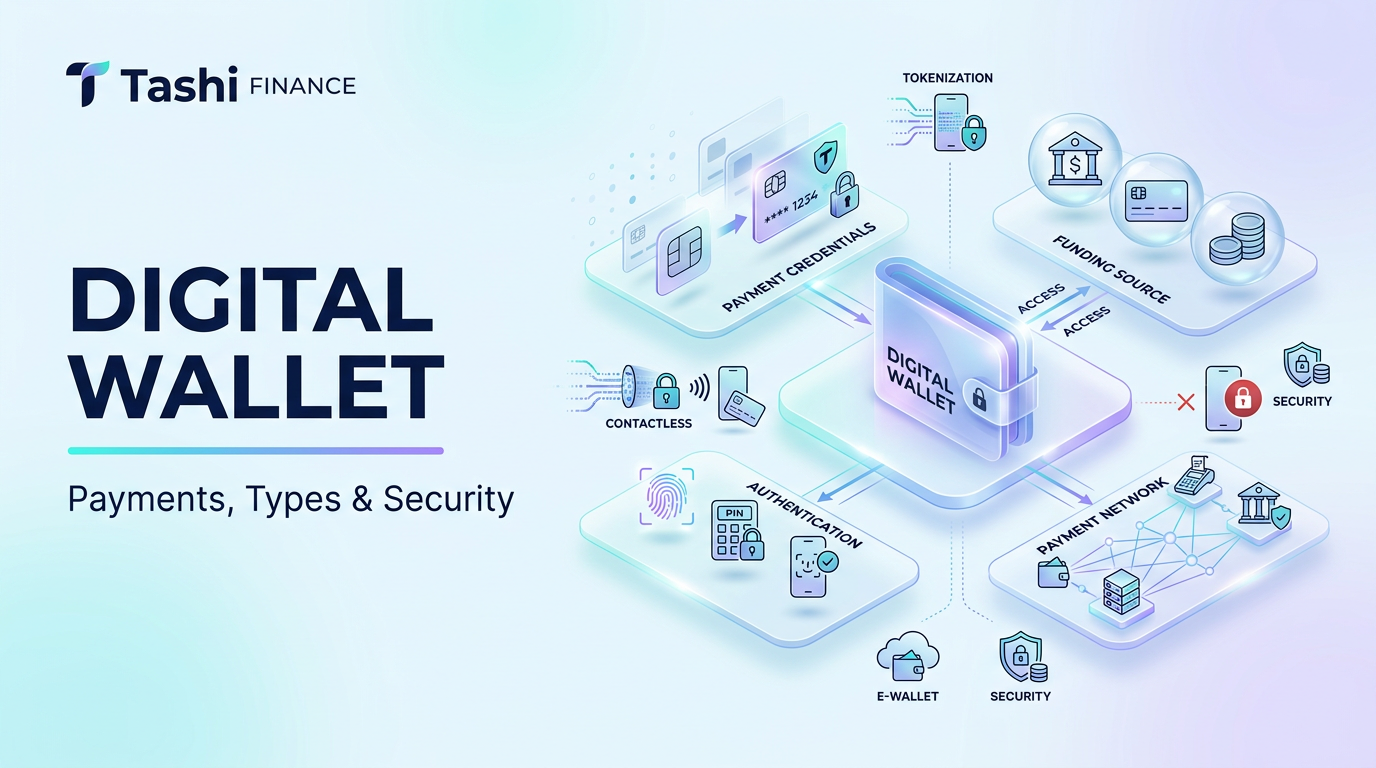
A digital wallet is an application or electronic service that allows users to store payment credentials, access linked funding sources, and authorize digital transactions. Depending on the wallet, it may connect to cards or bank accounts, hold stored value, or manage other payment instruments. A digital wallet does not necessarily store money directly inside the application.
The word “wallet” creates an easy mental picture.
A physical wallet contains cash and cards.
So it is natural to assume that a digital wallet works the same way.
Sometimes it does.
Sometimes it does not.
A digital wallet may simply provide secure access to a payment method stored elsewhere.
For example, an application can allow a user to pay with a linked card without the merchant receiving the original card number used to set up the wallet.
Another type of wallet may maintain an actual stored balance.
A third may provide access to a bank account or other funding source.
This creates an important distinction:
A digital wallet is the interface used to access and authorize value. The money itself may exist somewhere else.
Understanding this difference makes it much easier to understand how modern wallet payments actually work.
What Is a Digital Wallet?
A digital wallet is software or a digital service that helps a user manage payment methods and authorize transactions electronically.
Depending on the wallet, it may contain or connect to:
- payment card credentials;
- bank accounts;
- stored balances;
- loyalty credentials;
- tickets or passes;
- other digital payment instruments.
The wallet can provide a common interface between the user and those underlying payment methods.
For example, instead of entering card information every time a user buys something online, a wallet can allow the user to select a saved payment option and approve the transaction.
The wallet simplifies access.
The underlying financial system still processes the payment.
Digital Wallet Does Not Always Mean Stored Money
This is one of the most important concepts.
Imagine a user adds a payment card to a digital wallet.
The wallet may not actually receive the funds from the user’s bank account.
Instead, it may store or manage a protected payment credential associated with that card.
When the user makes a payment, the transaction can still ultimately depend on:
- the card account;
- the issuing bank;
- the relevant payment network.
The digital wallet acts as the access and authorization layer.
Compare that with a stored-value wallet.
A user may first transfer money into the wallet.
The service then maintains an internal balance that can be spent later.
Both products may be called digital wallets.
Their financial structure is different.
The Four-Layer Digital Wallet Model
A useful way to understand digital wallets is to separate four layers.
1. Wallet Interface
The application or device the user interacts with.
2. Payment Credential
The information used to initiate the payment.
3. Funding Source
The source from which value is drawn.
4. Payment Infrastructure
The financial systems that process and settle the transaction.
A simplified flow might look like this:
Digital Wallet → Payment Credential → Funding Source → Payment Network
The customer experiences one simple payment action.
Behind it, several different systems may be involved.
How Does a Digital Wallet Work?
The exact process depends on the wallet type and payment method.
A typical card-linked wallet may work like this:
- The user adds an eligible payment card.
- The wallet establishes or stores a protected payment credential.
- The user selects the wallet during a purchase.
- The user authenticates the transaction.
- The wallet supplies the required payment information.
- The payment request enters the normal payment processing infrastructure.
- The transaction is approved or declined.
- The merchant receives the payment result.
The wallet therefore does not replace the entire payment system.
It creates a more convenient and potentially more secure way for the customer to initiate the payment.
Digital Wallet Payment Flow
| Stage | What Happens | Main Purpose |
|---|---|---|
| Setup | User adds payment method | Connect funding source |
| Credential protection | Sensitive information is secured | Reduce data exposure |
| Checkout | User selects wallet | Start transaction |
| Authentication | User confirms payment | Verify authorization |
| Payment request | Wallet submits required data | Initiate transaction |
| Processing | Payment infrastructure handles request | Approve or decline |
| Confirmation | Result returns to merchant | Complete checkout |
This helps explain why a wallet payment can fail even when the wallet application itself appears to work normally.
The problem may occur further down the payment chain.
What Is a Mobile Wallet?
A mobile wallet is a digital wallet used primarily through a mobile device such as a smartphone.
A mobile wallet can support transactions through:
- online checkout;
- mobile applications;
- contactless payment;
- QR-based payment;
- other supported methods.
The terms digital wallet and mobile wallet are often used interchangeably.
Technically, digital wallet is the broader category.
A wallet accessed on a phone is a mobile wallet.
A digital wallet could also operate through:
- a web browser;
- another connected device;
- a desktop application.
Therefore:
Every mobile wallet is a digital wallet, but not every digital wallet must be limited to a mobile phone.
What Is an Electronic Wallet?
An electronic wallet, often called an e-wallet or e wallet, is another general term for a digital system used to store or access payment credentials and conduct electronic transactions.
In everyday usage, these terms often overlap:
- digital wallet;
- electronic wallet;
- e-wallet;
- mobile wallet.
However, providers may use the terminology differently.
The actual financial model is more important than the product name.
When evaluating a wallet, users should ask:
- Does it hold a stored balance?
- Does it connect to a card?
- Does it connect to a bank account?
- Who holds the underlying funds?
Those questions provide more useful information than the label alone.
Main Types of Digital Wallets
Digital wallets can be classified by how they access money or payment credentials.
Card-Linked Wallets
These wallets allow users to connect eligible payment cards.
The wallet provides a convenient way to authorize card payments.
Bank-Linked Wallets
Some wallets connect directly or indirectly to bank accounts.
The transaction may ultimately be funded from the linked account.
Stored-Value Wallets
These wallets maintain a balance that users can spend.
The user may first add funds before making transactions.
Merchant Wallets
Some businesses provide wallets primarily for use within their own ecosystems.
Multi-Purpose Wallets
These may support several payment methods and additional functions within one application.
The term digital wallet therefore describes a category rather than one single payment architecture.
Digital Wallet Types Compared
| Wallet Type | Where Value Comes From | Main Characteristic |
|---|---|---|
| Card-linked | Payment card account | Wallet initiates card payment |
| Bank-linked | Bank account | Payment draws from banking relationship |
| Stored-value | Preloaded wallet balance | Funds maintained within wallet structure |
| Merchant wallet | Linked or stored payment method | Designed around specific ecosystem |
| Multi-purpose | Multiple sources | Combines several payment options |
This distinction becomes especially important when considering security and consumer access.
Losing access to a wallet containing only a payment credential is different from losing access to an account holding an actual stored balance.
What Is a Digital Wallet App?
A digital wallet app is the software interface through which the user interacts with wallet functionality.
The application may allow users to:
- add payment methods;
- remove payment methods;
- select a payment option;
- authenticate transactions;
- review payment activity;
- manage wallet settings.
However, the application visible on the phone is only one layer.
The complete wallet service may also depend on:
- cloud infrastructure;
- payment networks;
- banks;
- token services;
- authentication systems.
This creates an important operational point:
A wallet app can work correctly while a payment still fails elsewhere in the financial infrastructure.
The visible application and the underlying payment system should not be treated as the same thing.
Digital Wallet vs Payment Gateway
A digital wallet and a payment gateway perform different functions.
The wallet is primarily a customer-facing payment method or interface.
The gateway helps the merchant connect checkout activity to payment processing infrastructure.
| Digital Wallet | Payment Gateway |
|---|---|
| Used by customer | Used by merchant |
| Stores or accesses payment credentials | Transmits payment requests |
| Helps authorize payment | Connects checkout to processing |
| Can be one payment option | Can support multiple payment options |
| Focuses on user payment experience | Focuses on merchant payment infrastructure |
A digital wallet payment can pass through a payment gateway.
The two technologies are therefore complementary rather than competing.
Digital Wallet vs Bank Account
A digital wallet is also not automatically a bank account.
A wallet may connect to a bank account.
It may also hold stored value through a separate financial structure.
The difference matters because:
- access rights can differ;
- custody arrangements can differ;
- protections can differ;
- withdrawal options can differ.
Users should understand where the underlying funds actually sit.
A balance displayed inside an application does not, by itself, explain the legal or financial structure behind that balance.
Digital Wallet vs Crypto Wallet
A digital payment wallet and a cryptocurrency wallet can both be called “wallets,” but they serve different purposes.
Digital Payment Wallet
Usually manages payment credentials or access to traditional funding sources.
Crypto Wallet
Typically manages cryptographic keys used to control blockchain-based assets.
A crypto wallet can provide direct control over digital assets through private keys.
A payment wallet may instead rely on:
- cards;
- banks;
- centralized payment services.
This distinction is important because losing access to a crypto wallet can create very different recovery problems from losing access to a conventional digital payment wallet.
Does a Digital Wallet Store Your Card Number?
Not necessarily in the form users might expect.
Many modern wallet systems use techniques designed to reduce exposure of the original payment credential.
One important technique is tokenization.
Instead of repeatedly using the original card number during payments, the system may use a substitute payment credential.
This substitute can be limited to particular devices or payment contexts.
The goal is to reduce the value of payment information if it is intercepted or exposed.
What Is Digital Wallet Tokenization?
Tokenization replaces sensitive payment information with a substitute value.
Consider the difference:
Original card credential
versus
Payment token
The merchant or payment system may use the token during the transaction instead of exposing the original credential in every step.
The token still connects the transaction to the correct payment account through the supporting payment infrastructure.
But the token itself may have limited usefulness outside its intended environment.
This can reduce certain forms of payment-data exposure.
Tokenization Does Not Make Fraud Impossible
This is an important misconception.
Protecting the payment credential solves only part of the security problem.
Attackers may still attempt to compromise:
- the user’s device;
- account credentials;
- authentication methods;
- recovery processes.
For example, an attacker may not need to steal a card number if they successfully take control of the user’s wallet account.
Security therefore requires multiple layers.
Digital Wallet Security
A digital wallet can use several security mechanisms.
Device Authentication
The wallet may require:
- a PIN;
- password;
- biometric verification.
Tokenization
Sensitive payment credentials may be replaced with payment tokens.
Encryption
Information can be protected during transmission or storage.
Transaction Authentication
Some transactions may require additional confirmation.
Device Controls
Users may be able to lock or remotely manage lost devices.
Fraud Monitoring
Connected payment providers may evaluate suspicious transactions.
No single control eliminates every risk.
Security depends on how these layers work together.
Does Losing Your Phone Mean Losing Your Money?
Not necessarily.
This is one of the most useful distinctions between a digital wallet and a physical wallet.
Suppose a physical wallet contains $200 in cash.
If the wallet is lost and someone finds the cash, recovery may be difficult.
Now suppose a smartphone contains a digital wallet connected to a payment card.
The phone may contain access credentials rather than the money itself.
The underlying funds may still remain:
- in a bank account;
- in a card account;
- within a separate wallet account.
If the wallet uses device authentication and remote security controls, a lost phone may not automatically provide another person with access to the funds.
However, the situation depends on the wallet design and account security.
A lost device should still be treated as a security event.
The Lost-Phone Risk Is Really an Access-Control Problem
The more useful question is not:
Is the money physically inside the lost phone?
It is:
Can someone use the lost phone to successfully authenticate payments or take control of the wallet account?
This shifts the security focus toward:
- screen locks;
- biometric protection;
- account recovery;
- remote device controls.
Understanding this distinction helps users respond to device loss more effectively.
Digital Wallet Security Tips
Several practical digital wallet security tips can reduce risk.
Protect the Device
Use a strong screen lock or available biometric security.
Protect the Wallet Account
Do not reuse weak passwords.
Secure Account Recovery
Email and other recovery channels can become attack targets.
Review Payment Activity
Unexpected transactions should be investigated quickly.
Keep Software Updated
Security updates can address known vulnerabilities.
Avoid Suspicious Links
Fake wallet pages and phishing messages may attempt to steal credentials.
Remove Unused Payment Methods
Keeping unnecessary credentials connected can increase exposure.
The most important principle is that wallet security extends beyond the wallet application itself.
The user’s device and recovery accounts matter as well.
A Secure Wallet Cannot Protect a Compromised User
Technology can protect credentials.
It cannot automatically prevent every social-engineering attack.
Consider a user who receives a fraudulent message.
The attacker convinces the user to approve a transaction voluntarily.
The wallet may:
- authenticate correctly;
- use secure tokenization;
- transmit the transaction securely.
The payment can still be fraudulent from the user’s perspective.
Technically, the system may have worked exactly as designed.
This illustrates an important distinction:
Secure transaction processing
does not guarantee:
Legitimate user intent
Security must therefore include user awareness as well as technology.
What Happens Behind a Contactless Wallet Payment?
A mobile wallet may support contactless payments through compatible devices and payment terminals.
A simplified flow can involve:
- User selects or activates the wallet.
- User authenticates if required.
- Device communicates payment information to the terminal.
- Payment credentials or tokens enter the payment processing system.
- Transaction is authorized.
- Payment result returns.
The customer experiences a short interaction.
Behind it is the broader digital payments infrastructure.
The wallet is the starting point, not the entire payment rail.
Contactless Payment Does Not Mean Money Moves Through NFC
This is another useful misconception to correct.
Contactless technology helps the customer’s device communicate payment information to the nearby payment terminal.
It does not necessarily represent the entire path that money follows.
A simplified structure is:
Phone → Payment Terminal → Payment Infrastructure → Financial Institution
The short-range communication occurs at the first step.
The financial transaction continues through additional systems.
Therefore:
The technology used to initiate a payment and the infrastructure used to settle the payment are different layers.
Online Digital Wallet Payments
Digital wallets can also simplify online checkout.
Instead of manually entering:
- card number;
- expiration date;
- other payment information;
the user may select a wallet and approve the payment.
This can reduce checkout friction.
But the wallet may still depend on traditional payment infrastructure behind the interface.
A more convenient checkout does not automatically mean a completely new payment system.
Digital Wallets and Payment Gateways
Merchants can offer digital wallets through their checkout systems.
A payment gateway may connect the merchant to:
- digital wallets;
- payment cards;
- bank-based payments;
- other methods.
From the customer’s perspective, the wallet is the selected payment method.
From the merchant’s perspective, the gateway helps route the payment into the required processing infrastructure.
Understanding these separate roles makes payment architecture much easier to analyze.
Digital Wallets and Open Banking
Some digital financial applications can also interact with bank-based infrastructure through open banking connections.
This differs from traditional card-linked wallet payments.
A wallet or payment application might provide access to several funding methods.
The visible customer experience can look similar while the underlying payment route differs.
This demonstrates a broader fintech trend:
One user interface can connect to multiple forms of financial infrastructure.
The customer sees one wallet.
Behind the interface may be several payment paths.
Convenience Can Increase Dependency
Digital wallets can make payments faster and easier.
But convenience can also concentrate access.
Imagine one wallet containing connections to:
- several payment cards;
- a bank account;
- stored value.
A single application now provides access to multiple financial relationships.
This increases convenience.
It can also make account security more important.
The wallet becomes a valuable access point.
This creates a useful principle:
The more payment methods a wallet connects, the more important protecting the wallet account becomes.
Common Digital Wallet Misconceptions
“The Wallet Always Stores My Money”
Not necessarily.
It may store payment credentials or access to another funding source.
“Digital Wallet and Crypto Wallet Mean the Same Thing”
They do not.
Crypto wallets generally manage blockchain keys, while payment wallets often manage traditional payment methods.
“Losing My Phone Means My Money Is Gone”
Not automatically.
The financial assets may remain elsewhere, although account access should be secured immediately.
“Tokenization Makes the Wallet Impossible to Hack”
No.
It protects certain payment credentials but does not eliminate account takeover or social engineering.
“Every E-Wallet Works the Same Way”
No.
Some hold balances, while others connect to cards or bank accounts.
“Contactless Means the Entire Payment Happens Through NFC”
No.
Contactless communication usually initiates the payment, while the transaction continues through broader payment infrastructure.
Digital Wallet Risks
Digital wallets can face several types of risk.
Account Takeover
An attacker may gain access to the wallet account.
Device Compromise
A compromised device may expose wallet functionality.
Phishing
Users can be tricked into revealing credentials or approving transactions.
Recovery Risk
Weak recovery processes can allow unauthorized access.
Provider Dependence
Users may depend on the wallet provider’s systems remaining available.
Funding-Source Risk
Problems with the linked bank or card can affect wallet payments.
Merchant Fraud
A secure wallet cannot guarantee that every merchant transaction is legitimate.
The risks depend on the wallet architecture.
A Better Framework for Evaluating a Digital Wallet
Before using a digital wallet, consider several questions.
1. What Does the Wallet Store?
Determine whether it stores:
- payment credentials;
- actual value;
- both.
2. What Is the Funding Source?
Understand where payments ultimately come from.
3. How Are Transactions Authenticated?
Look at device and account security.
4. What Happens if the Device Is Lost?
Understand the recovery and remote-control options.
5. Who Controls the Funds?
Identify the wallet provider, bank, card issuer, or other institution involved.
6. How Are Payments Processed?
Understand whether transactions use cards, bank transfers, or other infrastructure.
7. What Happens if the Wallet Provider Is Unavailable?
Determine whether payment credentials and funds remain accessible elsewhere.
Digital Wallet Evaluation Framework
| Question | Why It Matters |
|---|---|
| Does the wallet hold funds or credentials? | Reveals the wallet structure |
| What funding source is connected? | Shows where money comes from |
| How is the user authenticated? | Determines access security |
| Is tokenization used? | Affects credential exposure |
| What happens if the phone is lost? | Tests recovery planning |
| Can access be revoked remotely? | Helps limit device-loss risk |
| Which payment methods are supported? | Determines usability |
| What happens if the provider fails? | Reveals service dependency |
The best wallet is not necessarily the one with the longest feature list.
The right choice depends on how the user intends to pay and how the wallet manages access and security.
Digital Wallets and the Future of Payments
Digital wallets are becoming an important interface between consumers and modern payment infrastructure.
Their significance is not simply that they replace a physical wallet.
They can also create a common digital layer connecting:
- payment cards;
- bank-based payments;
- merchant services;
- identity and authentication.
This can make payments easier to initiate.
However, the underlying financial infrastructure still matters.
A digital wallet does not eliminate:
- banks;
- payment processors;
- payment gateways;
- financial networks.
Instead, it can make those systems less visible to the customer.
The user sees one button.
The transaction may involve many organizations.
Frequently Asked Questions
What is a digital wallet?
A digital wallet is an application or electronic service that stores or manages payment credentials and allows users to authorize digital transactions using linked cards, bank accounts, stored balances, or other supported payment methods.
How does a digital wallet work?
A digital wallet allows the user to select a stored or linked payment method, authenticate the transaction, and send the required payment information into the relevant payment processing system.
Does a digital wallet store money?
Sometimes. Some wallets maintain stored balances, while others primarily store or manage payment credentials linked to cards or bank accounts.
What is a mobile wallet?
A mobile wallet is a digital wallet accessed primarily through a smartphone or other mobile device.
What is an e-wallet?
An e-wallet, or electronic wallet, is another general term for a digital wallet used to access payment methods or conduct electronic transactions.
Is a digital wallet the same as a crypto wallet?
No. A digital payment wallet generally manages payment credentials or linked funding sources. A crypto wallet manages cryptographic keys used to control blockchain-based assets.
Are digital wallets secure?
Digital wallets can use tokenization, encryption, authentication, and other security controls, but users still face risks such as account takeover, phishing, device compromise, and social engineering.
What happens if I lose my phone with a digital wallet?
Losing a phone does not automatically mean losing the underlying money. Users should secure the device, protect the wallet account, and use available remote or recovery controls as quickly as possible.
What is digital wallet tokenization?
Digital wallet tokenization replaces sensitive payment credentials with substitute payment tokens that can be used for supported transactions while reducing exposure of the original credential.
Is a digital wallet a payment gateway?
No. A wallet is generally a customer-facing payment method, while a payment gateway connects merchant checkout systems to payment processing infrastructure.
Can a digital wallet use contactless payments?
Yes. Compatible mobile wallets can use contactless technology to communicate payment information to supported payment terminals.
Is an electronic wallet the same as a bank account?
Not necessarily. Some e-wallets connect to bank accounts, while others hold stored value or use different financial structures.
Final Takeaway
A digital wallet is best understood as a digital access layer for payments.
Sometimes it holds stored value.
Often it simply provides secure access to payment methods and funding sources held elsewhere.
This distinction explains why a digital wallet can connect to:
- payment cards;
- bank accounts;
- stored balances;
without replacing the financial systems behind them.
It also explains why losing a phone does not automatically mean losing the money associated with the wallet.
The more important question is whether someone can gain control of the payment credentials or wallet account.
The same principle applies to security.
Tokenization and device authentication can reduce risk, but they do not eliminate:
- phishing;
- account takeover;
- social engineering.
The most useful question is therefore not simply:
Which digital wallet is the most convenient?
A better question is:
What does the wallet actually store, where does the money come from, and how is access protected when something goes wrong?
Understanding those three points provides a much clearer picture of how digital wallets really work.
