What Are Cross-Chain Bridges? How They Work, Crypto Bridge Risks, and Interoperability
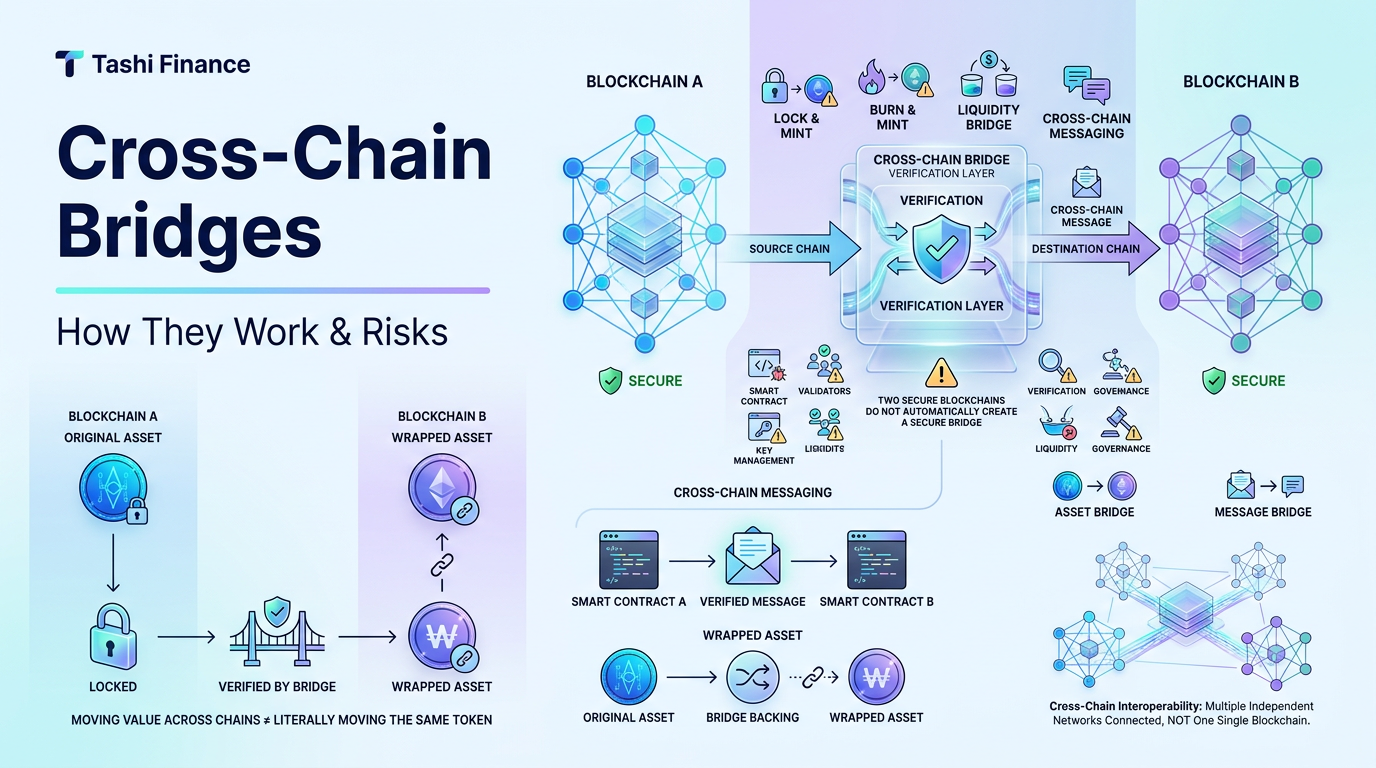
Cross-chain bridges are protocols that connect separate blockchain networks and allow assets, data, or instructions to be used across them. A bridge may lock assets on one chain and create a representation on another, burn and mint tokens across networks, provide liquidity for transfers, or verify cross-chain messages. The original asset does not always literally move between blockchains.
Blockchains are often described as open networks.
But open does not necessarily mean connected.
Two blockchain networks can operate independently, maintain different transaction histories, use different consensus mechanisms, and have no native ability to understand what happened on the other network.
A transaction confirmed on Blockchain A does not automatically become known to Blockchain B.
That creates a basic interoperability problem.
Cross-chain technology attempts to solve it.
But the word “bridge” can create a misleading mental picture.
A physical bridge allows the same car to travel from one side to another.
A blockchain bridge does not always move the exact same digital object from one blockchain to another.
Depending on the architecture, the original asset may remain locked on the source chain while another token is created on the destination chain.
Understanding that distinction is essential to understanding both how bridges work and why they can create new risks.
What Are Cross-Chain Bridges?
Cross chain bridges are systems that connect otherwise separate blockchain environments.
Depending on the design, a bridge may enable:
- token transfers;
- cross-chain messages;
- data transfers;
- smart contract instructions;
- governance actions;
- multichain applications.
The bridge acts as an interoperability layer.
A simplified structure looks like this:
Blockchain A
↓
Bridge or Verification Layer
↓
Blockchain B
The difficult part is not simply sending information.
The difficult part is convincing Blockchain B that something genuinely happened on Blockchain A.
For example:
How does Blockchain B know that a user really locked 100 tokens on Blockchain A?
Some system must verify that event before the destination network releases or creates corresponding value.
That verification mechanism is one of the most important parts of any bridge architecture.
Why Do Blockchains Need Bridges?
Independent blockchains generally maintain their own state.
This separation is a fundamental characteristic of blockchain technology, where each network maintains its own rules, transaction history, and consensus process.
Each network decides for itself:
- which transactions are valid;
- which accounts own assets;
- when transactions become final.
A blockchain normally cannot simply trust information arriving from another network.
Without an interoperability mechanism, digital assets and applications can become separated across ecosystems.
A user may hold assets on one network while wanting to use an application on another.
A business may operate services across several chains.
A decentralized application may need data from another blockchain.
Cross-chain infrastructure attempts to connect these environments.
The goal of cross-chain interoperability is therefore broader than simply transferring coins.
It is about allowing independent systems to coordinate.
A Cross-Chain Bridge Does Not Always Move the Same Token
This is one of the biggest misconceptions about crypto bridges.
Imagine a user owns 10 Token A units on Blockchain A.
The user wants to use equivalent value on Blockchain B.
A simple explanation might say:
The bridge moves the 10 tokens from Blockchain A to Blockchain B.
Technically, something different may happen.
The process could be:
10 Token A locked on Blockchain A
↓
Bridge verifies the lock
↓
10 representation tokens created on Blockchain B
The original tokens remain on the first network.
The destination network contains another token representing a claim connected to them.
So the more accurate statement is:
A cross-chain transfer may move economic value or ownership representation between networks without literally moving the original blockchain-native token.
That distinction becomes critical when analyzing bridge risk.
How Does a Cross-Chain Bridge Work?
A basic bridge transaction normally involves several stages.
1. User Initiates a Transfer
The user selects:
- source blockchain;
- destination blockchain;
- asset;
- amount.
2. Source-Chain Action Occurs
The source-side system may:
- lock tokens;
- burn tokens;
- transfer tokens into custody.
3. The Event Is Observed
The cross-chain system identifies that the required source-chain transaction occurred.
4. The Event Is Verified
The bridge determines whether the transaction is valid and sufficiently final.
5. A Destination Action Is Authorized
The destination system may:
- mint tokens;
- release existing tokens;
- deliver liquidity;
- execute a message.
6. User Receives Value or Executes an Action
The cross-chain operation is completed on the destination network.
The most important step is often number four:
Who or what verifies the source-chain event?
Different interoperability systems answer that question differently.
The Four-Layer Cross-Chain Model
A useful way to understand cross-chain infrastructure is to separate four layers.
| Layer | Function | Main Question |
|---|---|---|
| Source chain | Records original transaction | What happened on the origin network? |
| Verification | Confirms the event | Who proves the event is valid? |
| Communication | Transfers the verified information | How does the message reach the destination? |
| Destination chain | Executes the result | What happens after verification? |
Users often focus on the source and destination networks.
But the verification layer between them may introduce the largest additional trust assumption.
Main Types of Cross-Chain Bridges
There is no single bridge architecture.
Several models can achieve similar user outcomes through different mechanisms.
Lock and Mint
Assets are locked on the source network.
A corresponding token representation is minted on the destination network.
The basic structure is:
Lock Asset A
↓
Verify Lock
↓
Mint Wrapped Asset A
This model creates a direct relationship between locked collateral and the destination representation.
Burn and Mint
Tokens are destroyed or burned on one network.
Equivalent tokens are created on another.
The model can look like:
Burn Token on Chain A
↓
Verify Burn
↓
Mint Token on Chain B
This can be useful when the token architecture supports coordinated issuance across multiple networks.
Liquidity-Based Transfer
Instead of creating a wrapped asset for every transfer, a bridge can use existing liquidity.
A user provides an asset on the source network.
Liquidity is delivered to the user on the destination network.
The system later rebalances capital between networks.
Cross-Chain Messaging
A cross-chain system may transfer information rather than only assets.
For example:
Contract A sends instruction
↓
Cross-chain message verified
↓
Contract B executes instruction
This broader model can support multichain applications.
Cross-Chain Bridge Models Compared
| Model | Source Action | Destination Action | Main Dependency |
|---|---|---|---|
| Lock and mint | Asset locked | Representation minted | Backing and verification |
| Burn and mint | Token burned | Token minted | Authorized supply control |
| Liquidity bridge | Asset deposited | Existing liquidity released | Available liquidity |
| Message passing | Message generated | Instruction executed | Message verification |
Different designs solve different problems.
A bridge designed for token transfers is not necessarily equivalent to a general interoperability protocol.
What Is a Crypto Bridge?
A crypto bridge is a common term for infrastructure that allows users to transfer crypto-related value between blockchain networks.
The term can describe several different systems.
A crypto bridge might:
- lock and mint assets;
- burn and mint assets;
- swap through liquidity pools;
- route assets through several networks.
The visible user experience may look similar:
Select token → Select destination → Confirm transaction
But the architecture behind that interface can be fundamentally different.
This matters because the risks are different.
Two bridge products may appear to perform the same function while relying on completely different security assumptions.
Cross-Chain Bridges vs Blockchain Interoperability
A bridge is one approach to interoperability.
Interoperability is the broader concept.
A bridge may focus mainly on moving tokens.
A wider interoperability protocol may allow networks to exchange:
- arbitrary messages;
- application instructions;
- governance information;
- account actions;
- other data.
Therefore:
Every cross-chain bridge contributes to interoperability, but blockchain interoperability is broader than asset bridging.
The distinction becomes increasingly important as applications operate across multiple networks.
Asset Bridge vs Message Bridge
An asset bridge focuses primarily on transferring or representing value.
A message bridge communicates verified information.
Consider an asset bridge:
Lock 100 tokens on Chain A
→
Create 100 corresponding tokens on Chain B
Now consider cross-chain messaging:
User votes on Chain A
→
Verified message sent
→
Governance contract on Chain B records the vote
No asset necessarily needs to move.
The bridge is transferring an instruction.
This is why modern interoperability infrastructure can support much more than token transfers.
Cross-Chain Messaging and Smart Contracts
Cross-chain messaging can allow a smart contract on one network to trigger an action on another.
For example:
Smart Contract A
↓
Cross-Chain Message
↓
Verification
↓
Smart Contract B
This opens the door to applications that coordinate across multiple networks.
Potential use cases include:
- multichain governance;
- cross-chain asset management;
- coordinated applications;
- multichain financial services.
But greater functionality can also increase complexity.
A simple asset transfer has a limited outcome.
A generalized message may instruct another contract to perform an important action.
That means a failure in message verification can have consequences beyond one transfer.
The Verification Problem
Consider two secure blockchains.
Blockchain A has strong security.
Blockchain B also has strong security.
Does that guarantee that a bridge between them is equally secure?
No.
The bridge still needs a mechanism for deciding:
Did the source-chain event really occur?
Possible verification approaches can involve:
- external validator groups;
- multisignature systems;
- oracle-style mechanisms;
- native verification;
- light clients;
- cryptographic proofs.
Each design introduces different trade-offs.
This leads to one of the most important cross-chain principles:
Two secure blockchains do not automatically create a secure connection between them.
The security of the complete system also depends on the mechanism connecting the chains.
The Bridge as a New Trust Layer
Suppose:
Blockchain A is secure
and
Blockchain B is secure
but the bridge relies on a separate group of validators.
The effective structure becomes:
Security of Blockchain A
Security of Bridge Validators
Security of Blockchain B
The user now depends on more than the two blockchains.
The bridge has introduced another trust layer.
That does not automatically make the architecture unsafe.
But it means the user must understand what additional assumptions have been added.
The Weakest-Link Problem
Cross-chain security should be evaluated as a system.
Imagine:
Chain A → Bridge → Chain B
If Chain A is secure and Chain B is secure but the bridge can incorrectly authorize destination transactions, the security of the two blockchains does not solve the problem.
This creates a simple principle:
A cross-chain system can only be as reliable as the weakest critical component required to authorize the cross-chain action.
That critical component might be:
- smart contract logic;
- validator keys;
- message verification;
- liquidity custody;
- governance controls.
Looking only at the security reputation of the connected blockchains can therefore create a false sense of confidence.
Wrapped Assets and Cross-Chain Bridges
A wrapped asset is a digital token designed to represent another asset.
In some bridge models, the original asset is locked while a wrapped representation is issued elsewhere.
For example:
1 Original Token Locked
↓
1 Wrapped Token Minted
The wrapped token may trade and interact with applications on the destination network.
But its value depends on the connection to the underlying backing.
This creates two separate questions:
- Is the destination token technically functioning?
- Is the underlying backing still intact?
A wrapped token can function perfectly as software while the economic backing mechanism experiences a failure.
The Wrapped Asset Backing Problem
Suppose a bridge holds 1,000 original tokens.
It issues 1,000 wrapped tokens on another network.
In theory:
1 wrapped token = claim connected to 1 locked tokenNow imagine the locked collateral is compromised.
The wrapped tokens may continue to exist on the destination blockchain.
Their smart contracts may still function.
Wallets may still display balances.
But the economic relationship supporting those tokens has changed.
This demonstrates an important distinction:
Blockchain ownership of a wrapped token and economic backing of the wrapped token are separate layers.
A secure wallet cannot repair missing backing.
Crypto Bridge Security Risks
Bridge risk can come from several layers.
Smart Contract Risk
Errors in bridge code can cause incorrect transfers or expose assets.
Verification Risk
The system responsible for approving cross-chain messages may accept invalid information.
Validator Risk
A bridge relying on external validators may be vulnerable if enough validators are compromised or cooperate maliciously.
Key Management Risk
Administrative or validator keys can become critical security targets.
Wrapped Asset Risk
A destination asset may lose credible backing if locked collateral is compromised.
Liquidity Risk
Liquidity-based bridges may not always have enough usable capital on the required route.
Governance Risk
Privileged governance mechanisms may have the authority to change important bridge parameters.
Cross-chain security is therefore not one risk.
It is a chain of dependencies.
Bridge Security vs Blockchain Security
Blockchain security generally focuses on maintaining the integrity of one network.
Bridge security focuses on proving and acting on events across multiple networks.
The two problems overlap.
But they are not identical.
| Blockchain Security | Bridge Security |
|---|---|
| Protects one network’s state | Coordinates state between networks |
| Uses native consensus | May add another verification system |
| Validators agree on local events | Bridge must interpret remote events |
| Local smart contracts see local state | Cross-chain system communicates external state |
A blockchain can validate its own transactions correctly while still receiving a fraudulent cross-chain message from a compromised bridge.
Cross-Chain Finality Risk
Another difficult question is:
When is a source-chain transaction final enough to act on?
Different blockchains have different approaches to transaction finality.
A cross-chain system must decide when it is safe to treat a source event as irreversible.
If the system acts too early, the destination transaction may be executed before the source event is sufficiently settled.
If it waits longer, the bridge may become slower.
This creates another trade-off:
speed vs confirmation confidence
A faster cross-chain experience may require a different risk model from a slower system that waits for stronger confirmation.
What Happens During a Blockchain Reorganization?
A chain reorganization can alter which transactions are treated as part of the accepted blockchain history.
Consider this simplified situation:
- Bridge sees a deposit.
- Bridge sends a destination message.
- Destination assets are released.
- Source-chain history changes.
A bridge architecture must have rules for handling these possibilities.
The exact risk depends on:
- source blockchain design;
- confirmation requirements;
- bridge verification model.
This is why cross-chain systems cannot simply react to every observed transaction immediately.
They must define what counts as sufficiently verified.
Liquidity-Based Cross-Chain Bridges
A liquidity-based bridge can provide a different user experience.
Instead of waiting for an original asset to be locked and a representation minted, the bridge may use liquidity already available on the destination network.
The flow could look like:
User deposits Asset A on Chain A
↓
Bridge verifies transaction
↓
Liquidity provider releases Asset A on Chain B
This can make transfers faster or reduce the need for wrapped representations.
But it creates another dependency:
available liquidity
If the destination route lacks capital, execution conditions can deteriorate.
Cross-Chain Liquidity Is Fragmented
Liquidity can exist across multiple:
- chains;
- bridges;
- pools;
- assets.
This fragmentation creates a practical challenge.
A bridge may support both networks but still lack enough liquidity for a particular transfer route.
For example:
Chain A → Chain B: Deep liquidity
Chain A → Chain C: Limited liquidity
Chain B → Chain C: Moderate liquidity
Therefore:
A bridge supporting a network does not guarantee that every asset and route has equal transfer capacity.
Connectivity and usable liquidity are separate concepts.
Cross-Chain Interoperability Does Not Mean One Global Blockchain
Interoperability is sometimes described as creating one connected blockchain ecosystem.
That can be misunderstood.
Interoperability does not require all blockchains to become one blockchain.
Different networks can continue to maintain:
- separate consensus;
- separate validators;
- separate governance;
- separate transaction histories.
Interoperability creates communication between independent systems.
A useful analogy is not:
many blockchains becoming one
but:
many independent systems learning how to exchange verified information.
The independence remains.
The communication layer changes.
Cross-Chain vs Multichain
The terms cross-chain and multichain are related but not identical.
Multichain Application
An application exists on several blockchain networks.
Each deployment may operate partly independently.
Cross-Chain Application
Different deployments actively communicate or coordinate across networks.
For example, a protocol can launch separate applications on three chains.
That is multichain.
If those applications exchange verified messages and coordinate state, the architecture becomes cross-chain.
This distinction matters for businesses planning blockchain infrastructure.
Operating on several chains does not automatically mean those systems are interoperable.
Business Uses of Cross-Chain Technology
Cross-chain infrastructure can support several business models.
Multichain Financial Applications
Financial applications can offer services across several blockchain ecosystems.
Asset Transfers
Users can access digital assets on different networks.
Cross-Chain Governance
Votes or governance instructions can be communicated between networks.
Asset Management
Systems can coordinate positions or operations across chains.
Application Expansion
A blockchain-based business can reach users on multiple ecosystems without relying on one network.
Infrastructure Integration
Enterprise systems may use interoperability layers to connect different distributed ledger environments.
The business value comes from connectivity.
But every additional connection also creates another dependency that must be managed.
Cross-Chain Bridges and Digital Assets
Cross-chain bridges can expand where digital assets are used.
An asset initially issued or held on one blockchain may gain representation or liquidity on another network.
This can improve:
- accessibility;
- application compatibility;
- market reach.
But using an asset across several chains can also create fragmentation.
One economic asset may appear as:
- native token;
- wrapped token A;
- wrapped token B;
- bridge-issued representation C.
These versions may not always have identical:
- liquidity;
- backing;
- redemption mechanisms.
The name of the asset may look similar.
The underlying risk can be different.
The Multiple-Representation Problem
Imagine the same underlying asset appears on three networks through three different bridges.
The market now contains:
Original Asset
Wrapped Asset A
Wrapped Asset B
Wrapped Asset C
Each representation may have a separate backing mechanism.
If Bridge A fails, Wrapped Asset A may experience problems.
Wrapped Assets B and C may remain unaffected.
This demonstrates why users should ask:
Which specific representation of the asset do I own?
The ticker symbol alone may not provide enough information.
Can a Cross-Chain Bridge Create New Systemic Risk?
Yes, because cross-chain infrastructure can connect previously separate ecosystems.
Connectivity provides benefits.
It can also transmit problems.
Suppose a wrapped asset is widely used as collateral across several applications.
If confidence in the bridge supporting that asset collapses, the effects may spread beyond the bridge itself.
Potential consequences can reach:
- trading pools;
- lending systems;
- collateral positions;
- other connected applications.
This is a general property of financial connectivity:
Connecting systems can improve efficiency while also creating new channels through which failures propagate.
Interoperability therefore changes both opportunity and risk.
Common Cross-Chain Bridge Misconceptions
“The Same Token Physically Moves Between Blockchains”
Not always.
The original asset may remain locked while another representation is created elsewhere.
“A Secure Blockchain Means Its Bridges Are Secure”
No.
The bridge can introduce separate smart contract, validator, or verification risks.
“All Bridges Work the Same Way”
No.
Bridge architectures can use lock-and-mint, burn-and-mint, liquidity, or message-based models.
“Cross-Chain Means Multichain”
Not exactly.
Multichain applications can operate on several networks without communicating between them.
“Wrapped Tokens Are Identical to Native Assets”
They may provide similar economic exposure but can have additional backing and bridge dependencies.
“More Connected Chains Always Mean Better Interoperability”
Connectivity alone does not guarantee consistent security, liquidity, or user experience.
How to Evaluate a Cross-Chain Bridge
A stronger evaluation should begin with architecture rather than branding.
1. What Is Being Transferred?
Determine whether the system transfers:
- assets;
- wrapped representations;
- liquidity;
- messages.
2. Who Verifies Cross-Chain Events?
Understand the verification mechanism.
3. What Happens to the Original Asset?
Is it:
- locked;
- burned;
- transferred to custody?
4. What Is Created on the Destination?
Is the user receiving:
- native asset;
- wrapped representation;
- liquidity from another provider?
5. What Are the Trust Assumptions?
Determine whether security depends on:
- external validators;
- multisignature control;
- light clients;
- other verification systems.
6. What Happens if the Bridge Fails?
Understand whether existing destination assets remain redeemable.
7. Is Sufficient Liquidity Available?
For liquidity-based transfers, examine the relevant route.
8. Who Controls Upgrades?
Administrative authority can become a major security dependency.
Cross-Chain Bridge Evaluation Framework
| Question | Why It Matters |
|---|---|
| What does the bridge transfer? | Identifies the actual service |
| How is the source event verified? | Reveals the security model |
| What happens to source assets? | Explains custody or supply changes |
| What does the user receive? | Distinguishes native and represented assets |
| Who controls critical keys? | Reveals administrative risk |
| How are upgrades managed? | Shows governance dependencies |
| Is liquidity required? | Identifies route capacity risk |
| What happens during failure? | Tests system resilience |
| Can assets still be redeemed? | Measures backing reliability |
This framework is more useful than selecting a bridge based only on speed or transaction fees.
The Best Bridge Is Not Always the Fastest Bridge
Users naturally prefer fast transactions.
But speed is only one dimension.
A cross-chain system must balance:
- security;
- verification confidence;
- cost;
- connectivity;
- liquidity;
- convenience.
A faster bridge may rely on different verification assumptions.
A slower bridge may wait longer for source-chain confirmation.
Neither choice is automatically superior.
The correct question is:
What trade-offs create the speed?
Understanding the source of performance is more useful than comparing transaction times alone.
Cross-Chain Convenience Can Hide Complexity
A well-designed bridge can make a complicated process look simple.
The user sees:
Select asset
→
Select chain
→
Confirm
Behind that interface may be:
Source transaction
→
Finality check
→
Message verification
→
Relayer
→
Destination contract
→
Liquidity or token issuance
The interface hides complexity.
It does not remove it.
This creates an important risk-management principle:
Better user experience can reduce visible complexity without reducing underlying technical dependencies.
Businesses integrating cross-chain infrastructure still need to understand those dependencies.
Frequently Asked Questions
What are cross-chain bridges?
Cross-chain bridges are protocols that connect separate blockchain networks and enable assets, messages, or data to be used across them.
How does a cross-chain bridge work?
A bridge observes an event on a source blockchain, verifies that the event is valid, communicates the result, and triggers an action on a destination blockchain.
Do cross-chain bridges move the same crypto token?
Not always. Some bridges lock the original asset and create a wrapped representation on another network. Other designs burn and mint tokens or use existing liquidity.
What is a cross chain bridge in crypto?
A cross chain bridge in crypto is infrastructure that allows users or applications to transfer value or communicate between separate blockchain networks.
What is a crypto bridge?
A crypto bridge is another common term for a blockchain bridge used to transfer digital assets or related information between networks.
What is cross-chain interoperability?
Cross-chain interoperability is the ability of independent blockchain networks to exchange verified data, assets, or instructions while continuing to operate as separate systems.
What is the difference between a bridge and interoperability?
A bridge is a mechanism used to connect networks. Interoperability is the broader ability of those networks and applications to communicate and coordinate.
What is a wrapped asset?
A wrapped asset is a token representation connected to another underlying asset, often through a bridge or custody mechanism.
Are cross-chain bridges safe?
Cross-chain bridge safety depends on the bridge architecture, smart contracts, verification model, key management, governance, liquidity, and the security of the connected networks.
Why are bridges a security risk?
Bridges can introduce additional verification and trust layers between blockchains. A failure in those layers can affect cross-chain transfers even when the individual blockchains continue operating normally.
What is a liquidity bridge?
A liquidity bridge uses pools or liquidity providers to deliver assets on the destination network rather than relying entirely on minting wrapped representations.
What is cross-chain messaging?
Cross-chain messaging allows verified information or instructions to be communicated between applications on separate blockchain networks.
Is cross-chain the same as multichain?
No. Multichain usually means an application exists on multiple networks. Cross-chain generally means those networks or applications actively communicate.
What happens if a bridge fails?
The outcome depends on the architecture. Users may face problems involving transfers, liquidity, wrapped asset backing, redemption, or access to assets controlled by the bridge.
Final Takeaway
Cross-chain bridges exist because independent blockchains do not naturally share one common state.
A bridge creates a mechanism for connecting those separate environments.
But “moving crypto across chains” is often more complex than it appears.
The process may involve:
- locking an asset;
- burning an asset;
- minting another representation;
- providing destination liquidity;
- transmitting a verified message.
This is why the most important part of a bridge is not necessarily the visible transfer interface.
It is the mechanism that decides whether a cross-chain event should be trusted.
The key questions are:
Who verifies the transaction?
What happens to the original asset?
What does the user receive on the destination chain?
What new trust assumptions does the bridge introduce?
Two blockchains can each be secure while the connection between them introduces a separate point of failure.
At the same time, interoperability can create powerful business opportunities by allowing assets, applications, and information to operate across previously isolated ecosystems.
The most useful question is therefore not simply:
Which crypto bridge moves assets the fastest?
A better question is:
What exactly is moving between the networks, who verifies that movement, and what happens if the connection between the chains fails?
Understanding those three points provides a much clearer picture of how cross-chain bridges actually work.
