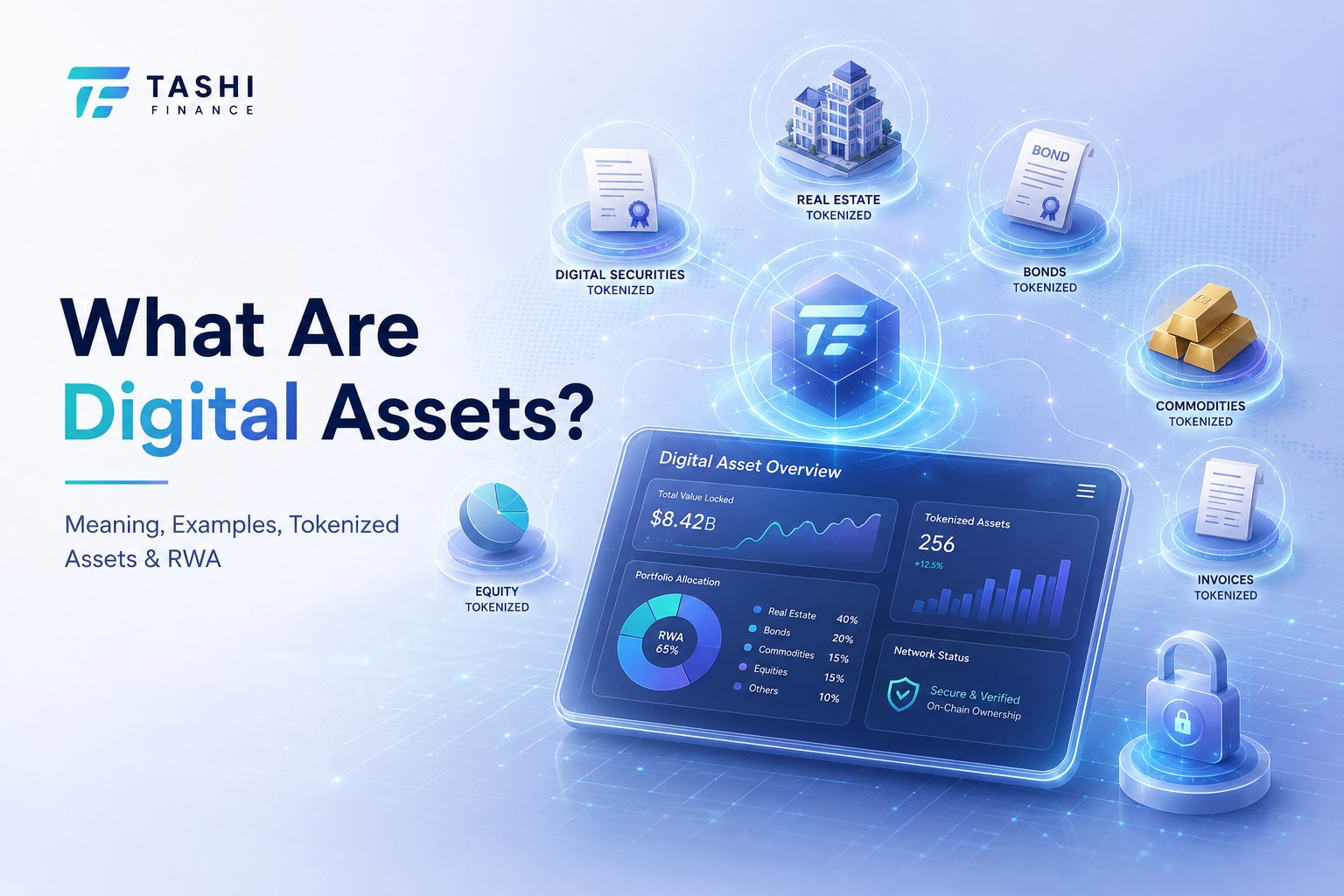
What Are Digital Assets? Types, Examples, Tokenization, and How They Work
Digital assets are electronically stored items that represent value, ownership, access, or other rights and can be created, transferred, or managed using digital systems. They range from cryptocurrencies and tokenized financial instruments to digital securities. The exact rights attached to a digital asset depend on its technology, legal structure, issuer, and custody arrangement.
The term can be confusing because it is used in several different industries.
A marketing team may call an image or video file a digital asset.
A financial institution may use the same term for a tokenized bond.
A cryptocurrency investor may use it to describe Bitcoin, stablecoins, or other blockchain-based tokens.
All of these uses can be technically valid.
But they refer to very different types of assets.
For investors and businesses, the most important question is therefore not simply:
Is this a digital asset?
A better question is:
What does this digital asset represent, who controls it, what rights does the holder receive, and how can those rights actually be enforced?
Understanding those distinctions is essential before evaluating value, custody, liquidity, or risk.
What Are Digital Assets?
In the broadest sense, digital assets are assets that exist in digital form and have some identifiable value, use, ownership, or access rights.
Examples can include:
- cryptocurrencies;
- stablecoins;
- tokenized assets;
- digital securities;
- blockchain-based tokens;
- digitally represented ownership rights;
- certain virtual items.
However, not every digital file should be treated as a financial asset.
A PDF document, photograph, or video can be called a digital asset in a content-management context.
But that is very different from a token representing a financial claim or an asset traded in a market.
For Tashi Finance, the term primarily refers to digitally represented financial or economic assets.
Digital Assets Meaning: The Important Distinction
The digital assets meaning depends heavily on context.
There are two broad interpretations.
Digital Content Assets
These include:
- images;
- videos;
- audio;
- design files;
- documents;
- brand materials.
Companies may store these through digital asset management software.
Financial Digital Assets
These may include:
- cryptocurrencies;
- tokenized financial instruments;
- digital securities;
- stablecoins;
- blockchain-based ownership or access tokens.
These assets may involve financial markets, custody, investment, settlement, or ownership rights.
The two categories share the word “asset,” but their business purposes are completely different.
That is why searches for digital asset management systems often lead to software for managing corporate media libraries rather than platforms for managing cryptocurrencies or tokenized investments.
Types of Digital Assets
Digital assets can be grouped according to what they represent.
| Type | What It May Represent | Common Purpose |
|---|---|---|
| Cryptocurrencies | Native blockchain value | Transfer, payment, speculation |
| Stablecoins | Value linked to another reference asset | Payments, settlement, trading |
| Tokenized assets | Digital representation of another asset or right | Ownership, transfer, investment |
| Digital securities | Digitally represented regulated financial instruments | Investment and capital markets |
| Utility tokens | Access or functionality | Use within a digital ecosystem |
| Digital collectibles | Unique digital ownership records | Collecting and digital ownership |
These categories can overlap.
For example, a token may have investment characteristics while also providing access to a digital service.
Its name alone does not determine its economic or legal function.
How Do Digital Assets Work?
The way a digital asset works depends on the infrastructure supporting it.
Blockchain-based assets generally rely on a distributed network that records transactions and tracks control of digital units.
A simplified process may look like this:
- A digital asset is created or issued.
- Ownership or control is represented through a digital record.
- A user controls the asset through an account, wallet, or custodian.
- A transfer request is initiated.
- The system verifies that the transfer follows the required rules.
- The ownership or control record is updated.
The exact process can differ significantly between cryptocurrencies, tokenized financial products, and conventional digital securities.
This means that “digital asset” describes a broad category rather than one single technology.
Digital Ownership vs Digital Control
One of the most important distinctions is the difference between owning an asset and controlling the digital credentials associated with it.
For some crypto assets, control of a private key may provide practical control over the asset.
For a tokenized real-world investment, possession of a token may not by itself determine every legal ownership right.
A token may instead represent:
- a contractual claim;
- beneficial ownership;
- access rights;
- entitlement to payments;
- ownership through a separate legal structure.
Therefore:
A blockchain record can show who controls a token, but the token’s legal documentation determines what that control actually represents.
This is especially important when physical or traditional financial assets are brought into digital markets.
Digital Assets Examples
Common digital assets examples include several distinct categories.
Cryptocurrencies
Cryptocurrencies are digitally native assets that operate through blockchain or similar distributed systems.
Their value may be influenced by:
- supply;
- demand;
- network adoption;
- liquidity;
- market sentiment.
Unlike tokenized assets, many cryptocurrencies do not represent ownership of another external asset.
Stablecoins
Stablecoins are digital tokens designed to maintain a value linked to another reference asset, commonly a national currency.
Their risk depends partly on how the price relationship is maintained.
Different designs may rely on:
- reserves;
- collateral;
- financial mechanisms;
- algorithms.
The word “stable” therefore does not mean every stablecoin has the same risk profile.
Tokenized Assets
Tokenized assets use digital tokens to represent some form of ownership, entitlement, or economic exposure.
The underlying subject might be:
- financial instruments;
- real estate interests;
- commodities;
- private market investments;
- other contractual rights.
The important point is that tokenization changes the representation and transfer mechanism.
It does not automatically change the economic quality of the underlying asset.
Digital Securities
Digital securities are financial securities represented or managed using digital infrastructure.
Depending on the structure, they may represent interests similar to traditional:
- shares;
- bonds;
- investment funds;
- other regulated instruments.
The fact that a security exists as a digital token does not necessarily remove the rules that normally apply to securities.
The technology and the financial instrument are separate layers.
What Are Crypto Assets?
Crypto assets are digital assets that rely on cryptographic and distributed-ledger technologies for their creation, transfer, verification, or control.
The category may include:
- cryptocurrencies;
- stablecoins;
- certain utility tokens;
- some tokenized assets.
Not every digital asset is a crypto asset.
For example, a digitally recorded conventional security held through a centralized financial system may be a digital asset without being a crypto asset.
Similarly, not every crypto asset represents a traditional investment or legal claim.
The economic function matters more than the label.
Digital Assets vs Crypto Assets
| Digital Assets | Crypto Assets |
|---|---|
| Broad category | More specific category |
| Can use centralized or decentralized systems | Usually relies on cryptographic or distributed systems |
| Includes digital securities and tokenized assets | Includes cryptocurrencies and blockchain tokens |
| May represent traditional financial rights | May be digitally native |
| Does not always use blockchain | Typically associated with blockchain or distributed ledgers |
A useful way to think about the relationship is:
Crypto assets are generally digital assets, but not all digital assets are crypto assets.
What Are Tokenized Assets?
A tokenized asset is an asset or right represented through a digital token.
The token acts as a digital representation.
The underlying economic value may exist:
- entirely on-chain;
- partly outside the blockchain;
- completely outside the blockchain.
For example, a token might represent an interest connected to a physical asset.
The physical asset itself does not suddenly move onto a blockchain.
Instead, a digital record is created that represents a defined relationship to that asset.
This distinction is fundamental.
How Does Tokenization Work?
A simplified tokenization process may involve:
- Identifying the underlying asset.
- Defining the legal rights associated with ownership.
- Creating a structure linking those rights to digital tokens.
- Issuing tokens on digital infrastructure.
- Establishing custody and transfer rules.
- Allowing approved participants to buy, sell, or transfer the tokens.
The technology layer may use blockchain technology, but the success of the structure depends on more than software.
It may also depend on:
- legal agreements;
- asset verification;
- custody;
- governance;
- identity checks;
- transfer restrictions.
This leads to an important principle:
Tokenizing an asset does not remove the need to manage the underlying asset.
What Is RWA in Crypto?
RWA in crypto usually means real-world assets represented or connected to blockchain-based tokens.
RWA stands for real-world asset.
Examples might involve digital representations connected to:
- real estate;
- bonds;
- commodities;
- private credit;
- other traditional assets.
The concept attempts to connect blockchain infrastructure with assets that exist outside purely digital crypto markets.
However, the phrase “real-world asset” can be misleading.
The blockchain does not directly hold a building, commodity, or legal contract.
It holds a digital record.
The value of that record depends on the structure connecting it to the underlying asset.
RWA Crypto Meaning
The practical RWA crypto meaning is therefore:
A blockchain-based token designed to represent or provide economic exposure to a real-world asset, financial instrument, or legally defined claim.
This definition highlights an important risk.
The token and the underlying asset are not automatically the same thing.
Several layers may exist between them.
For example:
Investor → Token → Issuer or Legal Entity → Ownership Structure → Underlying Asset
A failure at any of these layers can affect the token holder even when the blockchain continues working normally.
How Real World Asset Tokenization Works
Real world asset tokenization converts defined rights or economic interests into digitally represented units.
A simplified structure might involve:
Step 1: Identify the Asset
The issuer determines what will be represented.
Step 2: Verify Ownership
The underlying ownership must be established.
Step 3: Define Investor Rights
The structure must specify what the token holder receives.
Step 4: Create the Digital Token
Tokens are issued using digital infrastructure.
Step 5: Establish Custody
Both the underlying asset and the digital tokens may require custody arrangements.
Step 6: Enable Transfers
The token may then be transferred between eligible participants.
The most difficult part is often not creating the token.
It is maintaining the legal, operational, and financial connection between the token and the underlying asset.
The Tokenization Misconception
Tokenization is sometimes presented as if placing an asset on blockchain automatically creates:
- liquidity;
- transparency;
- lower costs;
- fractional ownership;
- easier global access.
These benefits may be possible.
They are not guaranteed.
A tokenized asset can still be:
- illiquid;
- difficult to value;
- legally complex;
- restricted to certain investors;
- expensive to administer.
Creating smaller digital units does not automatically create buyers.
Therefore:
Fractionalization can make an asset easier to divide, but it does not automatically make the asset easier to sell.
This distinction is especially important for traditionally illiquid assets.
What Is a Digital Asset Custodian?
A digital assets custodian or digital asset custodian is a service provider responsible for safeguarding digital assets or the credentials used to control them.
Traditional assets and digital assets can involve different custody challenges.
For many blockchain-based assets, control may depend on private cryptographic keys.
If those keys are:
- lost;
- stolen;
- exposed;
access to the asset can potentially be lost or compromised.
Custody arrangements may therefore include systems designed to protect key material and authorize transactions securely.
Self-Custody vs Third-Party Custody
| Self-Custody | Third-Party Custody |
|---|---|
| User controls access credentials | Custodian manages security infrastructure |
| Greater direct control | Less direct operational responsibility |
| User bears key-management risk | User depends on custodian |
| Can reduce counterparty dependence | Can provide institutional controls |
| Recovery can be difficult | Access depends on provider procedures |
Neither model eliminates risk.
Self-custody shifts more responsibility to the owner.
Third-party custody introduces dependence on another organization.
The correct approach depends on the asset, user, operational capability, and risk tolerance.
Digital Asset Trading
Digital asset trading involves buying and selling digital assets through markets or platforms.
Depending on the asset, trading may occur through:
- centralized exchanges;
- decentralized exchanges;
- broker platforms;
- regulated trading venues;
- private markets.
The trading structure can significantly affect risk.
A highly liquid cryptocurrency may trade continuously across many venues.
A tokenized private asset may have a much smaller group of eligible buyers.
Therefore, two digital assets may use similar token technology while having completely different market characteristics.
The broader mechanics of liquidity, price discovery, and trading are closely connected to how the crypto market works.
Digital Asset Price Does Not Equal Digital Asset Value
Another common mistake is treating the latest transaction price as proof of the value of every unit in existence.
A quoted price represents the level at which a recent transaction occurred.
It does not guarantee that every holder could sell at that price.
This becomes especially important when:
- trading volume is low;
- liquidity is limited;
- ownership is concentrated;
- transfer restrictions exist.
A digital asset may therefore have a visible market price while still being difficult to sell in meaningful size.
Why Companies Invest in Crypto Assets
Companies may consider crypto assets or other digital assets for different reasons.
Possible motivations include:
- exposure to new financial technologies;
- treasury strategies;
- customer demand;
- payment applications;
- investment opportunities;
- experimentation with digital markets.
However, a company adopting blockchain infrastructure does not automatically need to invest in cryptocurrency.
Similarly, a company can participate in tokenization without making speculative crypto investments.
Business use of digital infrastructure and investment exposure should be treated as separate decisions.
Benefits of Digital Assets
Potential benefits can include:
Programmability
Digital assets can interact with software and automated processes.
Transferability
Some assets can move between participants through digital networks.
Fractionalization
Economic interests may sometimes be divided into smaller units.
Transparency
Certain systems allow transaction histories to be independently reviewed.
Automation
Digital rules can automate parts of transfer or settlement processes.
Market Innovation
New asset structures and financial products can be created using digital infrastructure.
But each potential benefit depends on the specific implementation.
Risks of Digital Assets
Digital assets can introduce several categories of risk.
Market Risk
Prices may fluctuate substantially.
Liquidity Risk
An asset may be difficult to sell.
Custody Risk
Access credentials can be lost or compromised.
Technology Risk
Software failures or vulnerabilities can affect operations.
Counterparty Risk
Users may depend on issuers, exchanges, custodians, or other intermediaries.
Legal Structure Risk
The rights connected to a token may be unclear or difficult to enforce.
Underlying Asset Risk
A tokenized asset remains exposed to problems affecting the underlying investment.
Tokenization changes the infrastructure.
It does not remove fundamental financial risk.
Common Digital Asset Mistakes
Assuming Every Digital Asset Is Cryptocurrency
Cryptocurrency is only one part of the digital asset landscape.
Assuming Every Token Represents Ownership
A token may represent access, a contractual claim, or another type of right.
Ignoring Custody
Owning a valuable asset means little if access cannot be securely maintained.
Confusing Tokenization With Liquidity
A digital token does not automatically create an active market.
Ignoring the Underlying Asset
A poor investment does not become a good investment simply because it is tokenized.
Trusting the Technology but Ignoring the Structure
A blockchain can operate perfectly while the issuer, custodian, legal entity, or underlying asset fails.
The Four-Layer Digital Asset Framework
A useful way to evaluate a financial digital asset is to separate it into four layers.
1. Asset Layer
What creates the underlying economic value?
2. Legal Layer
What rights does the holder actually receive?
3. Technology Layer
How is ownership or control recorded and transferred?
4. Market Layer
Where can the asset be bought or sold?
Many digital asset risks become easier to identify when these layers are examined separately.
For example, an asset may have strong blockchain infrastructure but weak liquidity.
Another may have an active market but unclear legal claims.
A third may have solid legal documentation but poor custody arrangements.
No single layer tells the full story.
How to Evaluate a Digital Asset
Before investing in or using a digital asset, consider these questions.
| Question | Why It Matters |
|---|---|
| What does the asset represent? | Determines the source of value |
| What rights does the holder receive? | Defines legal and economic ownership |
| Who issues or controls the structure? | Identifies counterparty risk |
| How is the asset stored? | Determines custody risk |
| Where can it be traded? | Reveals market access |
| Is there meaningful liquidity? | Affects ability to exit |
| What happens if the platform fails? | Tests operational resilience |
| Is there an underlying asset? | Adds another layer of risk |
This framework is more useful than evaluating an asset based only on whether it uses blockchain.
Digital Assets and Financial Technology
Digital assets are part of the broader financial technology landscape.
They combine elements of:
- software;
- financial markets;
- payments;
- custody;
- investment products;
- blockchain infrastructure.
However, not every fintech company uses digital assets.
Likewise, not every digital asset project is primarily a fintech business.
The overlap depends on the product and its economic purpose.
Digital Assets and Digital Payments
Some digital assets can also be used in digital payments.
Stablecoins and other blockchain-based assets may be designed for transferring value.
But an asset used for payment still needs to solve practical problems involving:
- acceptance;
- settlement;
- security;
- liquidity;
- price stability.
A digital token does not automatically become an effective payment method simply because it can be transferred electronically.
Frequently Asked Questions
What are digital assets?
Digital assets are electronically stored assets that represent value, ownership, access, or other rights. Financial examples include cryptocurrencies, stablecoins, tokenized assets, and digital securities.
What is a digital asset?
A digital asset is an electronically represented item of value or rights that can be stored, transferred, or controlled through digital systems.
What are examples of digital assets?
Examples include cryptocurrencies, stablecoins, tokenized financial instruments, digital securities, and certain blockchain-based tokens.
Are digital assets the same as cryptocurrencies?
No. Cryptocurrencies are one type of digital asset. The broader category also includes tokenized assets, digital securities, and other digitally represented financial rights.
What are tokenized assets?
Tokenized assets are assets or rights represented through digital tokens. The token may represent ownership, an economic claim, access rights, or another legally defined relationship.
What is RWA in crypto?
RWA means real-world asset. In crypto, the term generally refers to blockchain-based tokens connected to assets or financial instruments that exist outside purely digital crypto markets.
What is real world asset tokenization?
Real world asset tokenization is the process of representing defined ownership rights or economic interests in an underlying asset through digital tokens.
Does tokenization make an asset liquid?
Not automatically. Tokenization can make ownership easier to divide or transfer, but liquidity still requires willing buyers, market access, and sufficient trading activity.
What does a digital asset custodian do?
A digital asset custodian helps safeguard digital assets or the cryptographic credentials used to control them.
Is digital asset management software used for cryptocurrency?
Usually, the phrase digital asset management software refers to systems for organizing corporate images, videos, documents, and other media files. It is a different category from financial digital asset custody or trading.
Final Takeaway
Digital assets are a broad category that extends far beyond cryptocurrency.
They can include crypto assets, stablecoins, tokenized assets, digital securities, and other digitally represented financial rights.
But the technology used to represent an asset is only one part of the picture.
Before evaluating any digital asset, it is important to understand:
- what creates its value;
- what legal rights it represents;
- who controls the underlying structure;
- how it is stored;
- where it can be traded;
- whether meaningful liquidity exists.
The same principle applies to tokenization.
Turning an investment into a digital token can change how ownership is recorded and transferred.
It does not automatically make the underlying asset safer, more valuable, or more liquid.
The strongest digital asset analysis therefore looks beyond the token itself and examines the entire structure connecting technology, ownership, custody, and the market.
