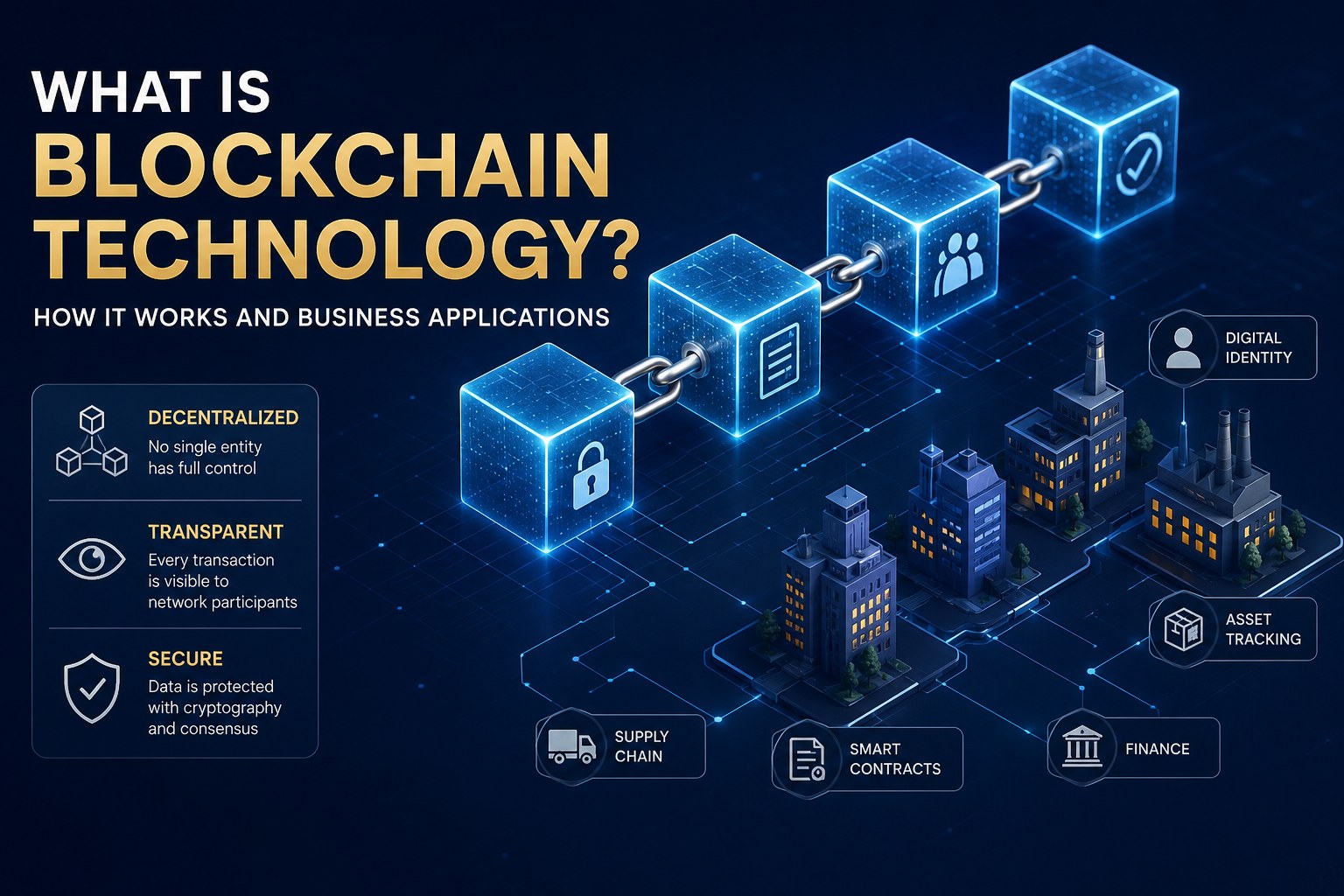
What Is Blockchain Technology? How It Works and Business Applications
Blockchain technology is a method of maintaining a shared digital record across a network of participants. Transactions or data changes are grouped into records, validated according to network rules, and linked cryptographically. Businesses can use blockchain when multiple parties need to share trusted records without giving one participant complete control over the database.
Blockchain became widely known through cryptocurrencies, but digital currencies represent only one possible application.
The broader business question is not simply whether an organization can use a blockchain.
The more useful question is:
Does a blockchain solve a coordination or trust problem that a conventional database cannot solve as efficiently?
That distinction is important because many projects become unnecessarily complex when blockchain is selected before the actual business problem is clearly defined.
What Is Blockchain Technology?
At a basic level, blockchain technology is a type of distributed record-keeping system.
Instead of one organization maintaining the only authoritative version of a database, multiple participants can maintain or verify copies of a shared record.
New information is added according to predefined network rules.
Depending on the blockchain design, participants may use different mechanisms to agree that a transaction or record is valid.
The system may include:
- distributed network nodes;
- cryptographic identifiers;
- transactions;
- blocks or other ordered records;
- consensus or validation rules;
- permissions;
- smart contracts.
Not every blockchain uses exactly the same architecture.
Public networks, private networks, and permissioned enterprise systems can operate very differently.
The shared characteristic is that participants use a structured system for maintaining records whose history is difficult to alter without detection.
How Does Blockchain Work?
The exact process varies by network, but a simplified blockchain transaction usually follows several stages.
- A participant creates a transaction or data request.
- The transaction is submitted to the network.
- Network participants or validators check whether it follows the required rules.
- Valid transactions are ordered and recorded.
- Cryptographic techniques connect the new record to the existing history.
- Authorized participants receive an updated version of the ledger.
This creates a shared history of transactions or records.
Simplified Blockchain Process
| Stage | What Happens | Business Purpose |
|---|---|---|
| Transaction creation | A participant submits new data | Starts a business event |
| Validation | Network rules check the transaction | Rejects invalid activity |
| Agreement | Participants determine the accepted record | Creates a common version |
| Recording | Valid data is added to the ledger | Preserves transaction history |
| Distribution | Updated records become available | Keeps participants synchronized |
| Verification | Previous activity can be reviewed | Supports auditability |
A traditional database can perform many of these tasks faster and more simply when one trusted organization controls the system.
Blockchain becomes more interesting when several organizations need to maintain a shared record but do not want one participant to have unilateral control.
What Is Blockchain Business?
The phrase blockchain business generally describes commercial activities that use blockchain infrastructure or provide blockchain-related products and services.
A business may interact with blockchain in several ways.
It might:
- build blockchain software;
- operate network infrastructure;
- use distributed records internally;
- participate in a shared industry network;
- issue or manage digital assets;
- automate processes using smart contracts;
- provide blockchain development or consulting services.
A business blockchain does not necessarily involve cryptocurrency.
Blockchain is also one part of the broader financial technology landscape when it is used to build financial infrastructure or services.
An enterprise system might use blockchain solely to coordinate records between suppliers, manufacturers, logistics companies, and customers.
The value comes from the shared data structure, not from speculative token trading.
Blockchain Technology vs a Traditional Database
One of the most important decisions is determining whether blockchain is actually necessary.
| Factor | Traditional Database | Blockchain-Based System |
|---|---|---|
| Control | Usually controlled by one organization | Can be shared across participants |
| Record changes | Authorized administrators can modify data | Historical changes are typically more constrained |
| Performance | Often faster and simpler | Can involve additional coordination |
| Trust model | Participants trust database owner | Trust can be distributed across network rules |
| Complexity | Usually lower | Usually higher |
| Best use | Centralized organization | Multi-party coordination |
A blockchain is not automatically a better database.
If one trusted organization owns the process and all participants accept its authority, a conventional database may be cheaper, faster, and easier to maintain.
This is one of the most important practical lessons for organizations considering blockchain solutions. NIST has similarly warned against adopting blockchain simply because it is a novel technology rather than because its properties match the problem.
Blockchain Applications in Business
The range of potential blockchain applications is broad, but the strongest business cases usually involve coordination between multiple parties.
Common areas include:
- supply chain traceability;
- shared business records;
- asset tracking;
- digital identity;
- financial transactions;
- automated agreements;
- certification and provenance;
- document verification.
The suitability of blockchain depends on how many parties are involved, who controls the data, and whether those parties already trust a central administrator.
Blockchain Technology in Supply Chain
Blockchain technology in supply chain is one of the most discussed enterprise applications.
A supply chain may involve:
- raw material suppliers;
- manufacturers;
- distributors;
- logistics providers;
- retailers;
- customers.
Each organization may maintain its own records.
Problems can occur when information is incomplete, inconsistent, delayed, or difficult to verify.
A shared ledger can potentially create a traceability record that follows a product or component through multiple organizations.
For example, participants might record:
- where a component originated;
- when it entered production;
- which organization handled it;
- when ownership or custody changed;
- when the final product was delivered.
NIST has explored blockchain and related technologies specifically for manufacturing supply-chain traceability, including the concept of building traceability records that can be followed backward toward original components.
What Blockchain Does Not Fix in a Supply Chain
Blockchain can help preserve records.
It cannot guarantee that the original information entered into the system was true.
Suppose a supplier enters:
Product inspected successfully.
The blockchain may preserve that statement accurately.
But if the inspection never happened, the technology does not automatically detect the lie.
This creates an important rule:
Blockchain can improve the integrity of recorded data after entry, but it does not automatically guarantee the accuracy of data at the point of entry.
Businesses still need reliable processes, sensors, audits, verification procedures, and accountable participants.
What Are Smart Contracts?
Smart contracts are programs stored and executed on blockchain infrastructure.
A smart contract can perform predefined actions when specified conditions are met.
For example:
If condition A is confirmed → execute action B.
Applications might include:
- transferring a digital asset;
- updating ownership records;
- releasing a payment;
- enforcing access rules;
- recording completion of a process.
Smart contracts can reduce some manual coordination, but they introduce another challenge: the code must accurately represent the intended business rules.
A mistake in the code can produce an incorrect result even when the blockchain itself operates exactly as designed. Ethereum’s official documentation describes smart contracts as programs stored on the blockchain whose behavior follows rules defined by their code.
How Businesses Can Use Blockchain Technology
When considering how to use blockchain technology, businesses should start with the workflow rather than the software.
A practical evaluation can follow five steps.
Step 1: Identify the Shared Record
What information needs to be shared?
Examples might include:
- ownership;
- transactions;
- certificates;
- product movements;
- approvals.
Step 2: Identify the Participants
Which organizations need access?
A system involving only one organization may not need distributed infrastructure.
Step 3: Identify the Trust Problem
Do participants fully trust one organization to control the database?
When the answer is yes, a traditional database may be sufficient.
Step 4: Define What Must Be Immutable
Which records must be protected against unauthorized alteration?
Not every piece of business data needs permanent historical preservation.
Step 5: Compare Alternatives
Compare blockchain with:
- centralized databases;
- shared cloud platforms;
- APIs;
- conventional audit systems.
Blockchain should win the comparison based on business requirements, not novelty.
Public vs Private vs Permissioned Blockchain
Blockchain architecture can vary significantly.
Public Blockchain
A public blockchain generally allows broad network participation.
Public networks often prioritize openness and resistance to centralized control.
Private Blockchain
A private blockchain limits participation to a controlled group.
One organization may manage access.
Permissioned Blockchain
A permissioned network restricts specific activities to approved participants.
For example, only authorized companies may be allowed to:
- submit transactions;
- validate records;
- view sensitive information.
For many enterprise applications, access control is important because businesses may not want confidential commercial data exposed publicly.
Benefits of Blockchain
The potential benefits of blockchain depend heavily on the use case.
Shared Source of Records
Organizations can coordinate around a shared history rather than constantly reconciling separate databases.
Traceability
Records can help participants follow the history of an asset, component, or transaction.
Auditability
Historical activity can be easier to review when records are consistently preserved.
Reduced Dependence on One Database Owner
Network participants may not need to give one organization complete unilateral control.
Process Automation
Smart contracts can automate some predefined actions.
Digital Asset Management
Blockchain infrastructure can support digital representations of assets and ownership rights.
These benefits are not automatic.
A poorly designed blockchain system can be more expensive and difficult to operate than the centralized process it replaces.
The Biggest Misconception: Blockchain Removes Trust
Blockchain is often described as a technology that eliminates trust.
That description is incomplete.
Blockchain changes where trust is placed.
Instead of trusting only one database administrator, participants may need to trust:
- network software;
- validation rules;
- smart contract code;
- identity systems;
- governance processes;
- external data providers.
When a blockchain application relies on information from outside the network, additional systems may be needed to bring that data on-chain.
Therefore, the real advantage is usually not “trustlessness.”
A better description is:
Blockchain can redistribute trust across technology, participants, and governance rules.
Common Blockchain Business Mistakes
Using Blockchain Without a Multi-Party Problem
If one organization owns the entire process, distributed consensus may add unnecessary complexity.
Putting Bad Data on an Immutable Ledger
Immutable incorrect data is still incorrect.
Data verification must happen before or during entry.
Ignoring Governance
Technical rules do not answer every business question.
Organizations still need to decide:
- who can join;
- who can change rules;
- what happens during disputes;
- who manages upgrades.
Assuming Smart Contracts Eliminate Legal Agreements
Code can automate execution.
It does not automatically resolve every legal, contractual, or regulatory issue.
Building Before Defining the Business Problem
A common failure pattern is:
Choose blockchain → search for a problem.
The better sequence is:
Define problem → compare architectures → choose blockchain only if justified.
When Blockchain Is the Wrong Solution
Blockchain is probably unnecessary when:
- one trusted organization controls the process;
- records need frequent unrestricted editing;
- maximum transaction speed is the primary requirement;
- participants already use an effective shared database;
- decentralization provides no meaningful benefit.
In these situations, a centralized database may be the better architecture.
This is not a failure of blockchain.
It simply means the business problem does not require its specific characteristics.
A Better Blockchain Decision Framework
Before starting a blockchain project, ask five questions.
| Question | Why It Matters |
|---|---|
| Are multiple independent parties involved? | Blockchain is most relevant to shared workflows |
| Do the parties need a common record? | A shared ledger must solve a real coordination problem |
| Is there disagreement over who should control the data? | Distributed governance may add value |
| Does record history need strong tamper resistance? | Immutability must serve a practical purpose |
| Is blockchain better than a shared database? | Complexity should produce measurable value |
If most answers are “no,” blockchain may not be necessary.
Blockchain and Digital Payments
Blockchain can be used as infrastructure for some forms of digital payments, particularly when digital assets or blockchain-based settlement systems are involved.
However, blockchain payments and traditional digital payment systems are not the same thing.
Card networks, bank transfers, mobile wallets, and other payment systems can operate entirely without blockchain.
The correct technology depends on the payment problem being solved.
Blockchain and the Crypto Market
Blockchain technology provides infrastructure for many cryptocurrencies and digital assets traded in the crypto market.
However, blockchain technology and cryptocurrency trading are different topics.
A company can use blockchain for:
- records;
- traceability;
- identity;
- automation;
without participating in cryptocurrency speculation.
This distinction matters because business adoption of blockchain does not automatically imply exposure to cryptocurrency price volatility.
Frequently Asked Questions
What is blockchain technology?
Blockchain technology is a system for maintaining shared digital records across a network. Participants validate and record transactions according to predefined rules, creating a history that is difficult to alter without detection.
How does blockchain work?
Blockchain works by receiving transactions or data, validating them according to network rules, recording accepted information, and distributing updated records across authorized network participants.
What is blockchain business?
Blockchain business refers to commercial activities involving blockchain infrastructure, applications, development, digital assets, or business processes built on distributed ledger technology.
What are blockchain applications?
Blockchain applications can include supply chain traceability, shared record keeping, asset tracking, digital identity, smart contracts, document verification, and digital asset management.
What are the benefits of blockchain?
Potential benefits include shared records, traceability, auditability, process automation, and reduced dependence on a single database administrator. The actual value depends on the business problem.
Is blockchain the same as cryptocurrency?
No. Cryptocurrency is one application of blockchain technology. Blockchain can also be used for business records, supply chains, identity systems, smart contracts, and other applications.
Does every business need blockchain?
No. Businesses with a trusted central administrator and an effective conventional database may gain little from adding blockchain technology.
Can blockchain data be wrong?
Yes. Blockchain can preserve a record, but it cannot automatically guarantee that information was accurate when originally entered.
Final Takeaway
Blockchain technology is most valuable when several independent participants need to coordinate around a shared record and no single participant should have complete control over that record.
The technology can support supply chain traceability, shared business records, smart contracts, digital assets, and other applications.
But blockchain should not be treated as a universal replacement for conventional databases.
For businesses, the best starting point is not:
How can we use blockchain?
The better question is:
What problem are we trying to solve, and is blockchain genuinely the best architecture for solving it?
A successful blockchain business project begins with a clear coordination problem, realistic governance, reliable data, and a measurable reason for choosing distributed infrastructure.
