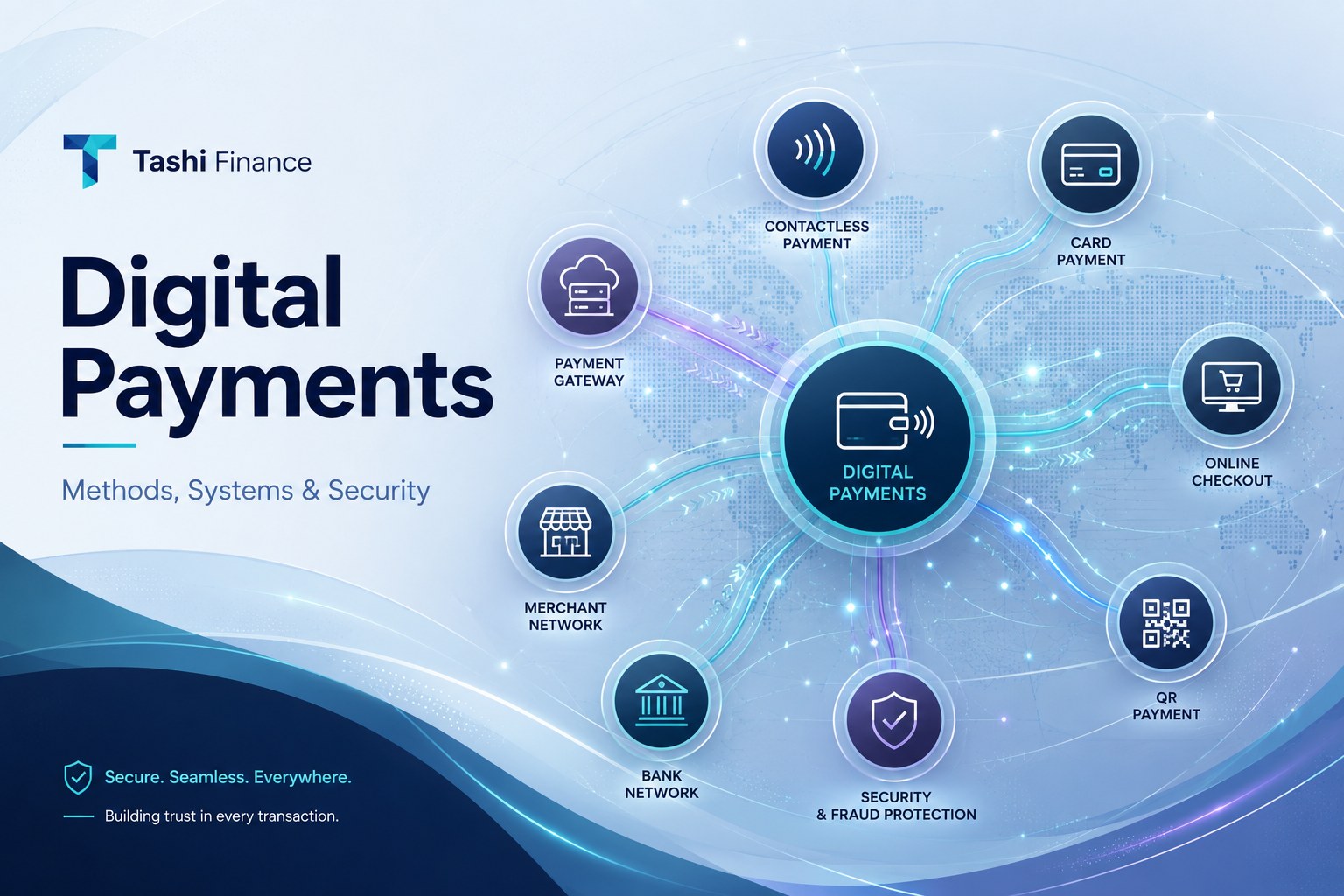
What Are Digital Payments? Types, Examples, and How They Work
Digital payments are transactions in which money or payment information is transferred electronically rather than through physical cash. They include card transactions, bank transfers, mobile wallets, online payments, and other electronic methods. A digital payment typically connects the customer, merchant, payment technology providers, and financial institutions before the transaction is authorized and ultimately settled.
Digital transactions have become part of everyday commerce, but the process behind them is often more complex than the customer sees.
A buyer may tap a phone, enter card details, or approve a bank transfer in seconds. Behind that simple action, several systems may need to verify the customer, check available funds, assess fraud risk, route transaction information, authorize the payment, and later move funds between financial institutions.
Understanding this process is useful for both consumers and businesses because a successful payment involves more than simply pressing a button.
What Is a Digital Payment?
A digital payment is an electronic transfer of value between a payer and a recipient.
The payer may be an individual or business. The recipient may be a merchant, service provider, government agency, financial institution, or another individual.
The transaction does not require physical cash to move directly between the two parties.
Common examples include:
- paying with a debit or credit card;
- sending money through a mobile wallet;
- making a bank transfer online;
- paying an invoice electronically;
- using a contactless phone or card;
- completing a purchase through an online checkout.
The term overlaps with electronic payment, although different industries may use the terminology in slightly different ways.
In practical terms, both usually describe payments in which transaction information and value move through electronic systems.
How Do Digital Payments Work?
A digital transaction may appear instant to the customer, but several steps can occur behind the interface.
The exact process depends on the payment method, but a typical transaction involves:
- The customer initiates the payment.
- Payment information is securely transmitted.
- The customer’s identity or payment credentials may be authenticated.
- The transaction is checked for fraud or other risks.
- The relevant financial institution approves or declines the request.
- The merchant receives a transaction result.
- Funds are cleared and settled according to the payment system being used.
This distinction between authorization and settlement is important.
A payment can appear successful to the customer before the merchant has actually received the final funds.
The Digital Payment Flow
| Stage | What Happens | Why It Matters |
|---|---|---|
| Initiation | Customer chooses a payment method | Begins the transaction |
| Authentication | Identity or credentials may be verified | Helps prevent unauthorized use |
| Authorization | Payment is approved or declined | Confirms whether the transaction can proceed |
| Processing | Payment information moves through relevant systems | Connects the parties involved |
| Clearing | Transaction obligations are calculated | Prepares the transfer of funds |
| Settlement | Funds move between financial institutions | Completes the financial transfer |
| Reconciliation | Merchant records are matched with payments received | Helps identify missing or incorrect transactions |
For a business, the final step is especially important.
A checkout page may report that 100 customers paid successfully, but the company’s accounting records still need to match those transactions with the funds actually received.
This is why payment operations are not only a customer-experience issue. They are also an accounting and financial-control issue.
Types of Digital Payment Methods
Different digital payment methods solve different problems.
Some are designed for retail purchases. Others are better suited to recurring subscriptions, business invoices, international transactions, or person-to-person transfers.
Card Payments
Debit and credit cards remain a common way to make electronic transactions.
Customers can use physical cards in stores or enter card information during an online purchase.
Contactless cards can also communicate with compatible payment terminals without being inserted into a reader.
Online Payments
Online payments are transactions completed through websites, applications, or other internet-connected services.
Common examples include:
- e-commerce purchases;
- subscription payments;
- online bill payments;
- digital service purchases;
- booking and reservation payments.
The term describes the environment in which the transaction takes place rather than one specific payment technology.
An online purchase might ultimately be funded by a card, bank account, wallet, or another payment method.
Mobile Payments
A mobile payment is initiated or completed using a smartphone or another mobile device.
This can include:
- mobile wallets;
- in-app purchases;
- QR-code payments;
- contactless phone payments;
- person-to-person payment applications.
Mobile devices can combine payments with biometric authentication, location data, and other security features.
Bank Transfers
Electronic bank transfers allow money to move directly between bank accounts.
They are commonly used for:
- invoices;
- salaries;
- recurring payments;
- large purchases;
- business-to-business transactions.
Depending on the payment network and country, transfers may be immediate or may take additional time to settle.
Digital Wallets
A digital wallet stores payment credentials or allows users to access payment methods through an application.
The wallet itself does not always hold the customer’s money.
In many cases, it acts as a secure interface between the user and an underlying card, bank account, or stored-value balance.
Contactless and NFC Mobile Payments
NFC mobile payments use near-field communication to exchange information between compatible devices over a very short distance.
A customer can typically hold a smartphone or wearable device near a payment terminal to initiate the transaction.
Contactless technology improves convenience, but the financial process behind the transaction still involves payment credentials, authorization, processing, and settlement.
What Is a Digital Payment System?
A digital payment system is the broader combination of technologies, institutions, rules, and processes that allows electronic transactions to take place.
A payment system may involve:
- customers;
- merchants;
- banks;
- payment processors;
- card networks;
- wallet providers;
- gateways;
- fraud detection services;
- authentication systems.
This is an important distinction.
A payment application is not necessarily the payment system itself.
The application may simply provide the visible interface while several organizations and technologies operate behind it.
What Is a Digital Payment Gateway?
A digital payment gateway is technology that helps securely transmit payment information between a merchant’s checkout environment and the systems responsible for processing the transaction.
For an online business, the gateway is often one part of a larger payment stack.
It may help:
- collect payment information;
- encrypt or tokenize sensitive data;
- transmit transaction requests;
- return approval or decline messages.
A gateway should not automatically be confused with a payment processor or financial institution.
One company may provide several of these functions, but the roles are technically different.
Gateway vs Processor vs Bank
| Component | Primary Role |
|---|---|
| Payment gateway | Securely captures and transfers payment information |
| Payment processor | Handles transaction communication and processing |
| Financial institution | Holds accounts or participates in movement of funds |
| Merchant platform | Provides the customer-facing checkout experience |
| Fraud system | Evaluates transaction risk |
For businesses choosing digital payment services, understanding these roles can help when comparing fees, reliability, security responsibilities, and integrations.
Digital Payments vs Cashless Payments
The terms digital payments and cashless payments are closely related but not identical.
A cashless payment simply means that physical cash is not used.
That can include many electronic methods, but the term focuses on the absence of cash.
Digital payment is a more technology-focused concept that describes how transaction information and value are transferred through electronic systems.
In everyday use, however, the two terms frequently overlap.
The Role of Digital Payments in Digital Finance
Payments are one of the most visible areas of digital finance.
They connect consumers, businesses, financial institutions, and technology platforms.
Improvements in payment infrastructure can affect:
- e-commerce;
- business cash flow;
- subscription services;
- international commerce;
- financial applications;
- embedded finance.
But payments are only one part of the wider digital finance ecosystem.
Lending, investing, insurance, banking technology, financial data, and digital assets are separate areas that may interact with payment systems.
Benefits of Digital Payments
Digital payment technology can offer several advantages.
| Benefit | Practical Impact |
|---|---|
| Convenience | Customers can pay without carrying physical cash |
| Speed | Many transactions can be initiated within seconds |
| Remote commerce | Businesses can accept payments from online customers |
| Automation | Payments can connect with accounting and business software |
| Record keeping | Electronic transactions create digital records |
| Scalability | Businesses can process larger transaction volumes |
| Payment choice | Customers can select from multiple payment methods |
However, these benefits depend on reliable technology and appropriate financial controls.
A fast checkout experience is not useful if the payment later fails, cannot be reconciled, or produces excessive fraud losses.
Challenges in Digital Payments
The most important challenges in digital payments are often invisible to customers until something goes wrong.
Fraud
Criminals may attempt to use stolen credentials, compromised accounts, social engineering, or other methods to initiate unauthorized transactions.
Businesses therefore need to balance fraud prevention with customer convenience.
Extremely strict controls can block legitimate customers, while weak controls can increase losses.
Failed Payments
Transactions can fail for many reasons:
- incorrect payment information;
- insufficient funds;
- authentication failure;
- technical interruptions;
- issuer declines;
- expired credentials.
A failed payment is especially important for subscription businesses, where repeated failures can directly affect recurring revenue.
Chargebacks and Disputes
Some payment methods allow customers to dispute transactions.
Businesses need clear records showing what was purchased, when the transaction occurred, and how the product or service was delivered.
Poor documentation can make disputes harder to resolve.
Security
Payment data is highly sensitive.
Businesses must consider how payment information is collected, transmitted, and stored.
Reducing unnecessary exposure to sensitive payment data can reduce some security risks.
Operational Dependence
A business may rely on several external providers to accept payments.
If a gateway, processor, bank, network, or critical infrastructure provider becomes unavailable, transactions may be disrupted even when the merchant’s own website is working normally.
This creates an important operational lesson:
A payment system is only as reliable as the chain of services required to complete the transaction.
Why a Successful Checkout Does Not Always Mean a Completed Payment
One of the most common payment misconceptions is treating the customer’s confirmation screen as the end of the transaction.
In reality, several things may still happen afterward.
A transaction may require:
- settlement;
- reconciliation;
- fraud review;
- refund processing;
- dispute management.
For merchants, this means payment performance should not be measured only by checkout conversion.
A more complete view also considers:
- authorization rate;
- payment failure rate;
- fraud losses;
- disputes;
- settlement timing;
- reconciliation errors.
A payment method that creates slightly more friction at checkout may still be more valuable if it produces fewer disputes or operational problems.
How Businesses Should Evaluate Digital Payment Services
Businesses should not choose payment technology based only on transaction fees.
A better framework includes several factors.
Customer Fit
Which payment methods do customers actually prefer?
A payment option that is popular in one market may be uncommon in another.
Transaction Type
The best solution may differ for:
- one-time purchases;
- subscriptions;
- business invoices;
- high-value transactions;
- international payments.
Reliability
Businesses should understand what happens when systems fail.
Questions include:
- Can customers retry easily?
- Are failed payments clearly reported?
- Is there a backup payment option?
- How quickly are outages resolved?
Security and Fraud Controls
The appropriate level of fraud protection depends on transaction value, customer behavior, and business model.
Integration
Payment systems often need to connect with:
- e-commerce platforms;
- accounting tools;
- subscription software;
- customer databases.
Poor integrations can create manual work even when the payment itself functions correctly.
Total Cost
Transaction fees are only one part of payment cost.
Businesses may also face:
- currency conversion costs;
- dispute fees;
- integration costs;
- fraud losses;
- operational expenses.
The cheapest advertised rate is therefore not always the lowest-cost solution overall.
Common Digital Payment Mistakes
Offering Too Many Payment Methods
More choice is not automatically better.
Supporting many rarely used methods can increase technical complexity without meaningfully improving conversion.
Focusing Only on Checkout Speed
A fast checkout is useful, but reliability, fraud, reconciliation, and settlement also matter.
Ignoring Failed Payments
A business that does not monitor declines may lose customers and revenue without understanding why.
Treating All Markets the Same
Payment preferences differ by country, industry, transaction size, and customer type.
Forgetting Reconciliation
Receiving money and correctly identifying what each payment relates to are separate operational tasks.
As transaction volume increases, manual reconciliation can become a significant problem.
Digital Payments and the Future of Commerce
Digital payment technology is increasingly becoming embedded inside broader customer experiences.
A payment may happen inside:
- an online marketplace;
- a mobile application;
- business software;
- a subscription platform;
- a digital wallet.
As this integration increases, customers may see less of the underlying payment infrastructure.
The transaction may feel like a simple feature of another product.
For businesses, however, the underlying challenges remain: payments must still be authorized, secured, settled, recorded, and reconciled.
The future of payments is therefore not only about making transactions faster.
It is also about making the entire payment process more reliable, integrated, secure, and easier to manage.
Frequently Asked Questions
What are digital payments?
Digital payments are transactions in which payment information or money is transferred electronically instead of using physical cash. Common examples include card payments, bank transfers, mobile wallets, online payments, and contactless transactions.
What is an electronic payment?
An electronic payment is a transaction processed through electronic systems. The term is often used similarly to digital payment and can include cards, bank transfers, online transactions, and mobile payment methods.
What is a digital payment system?
A digital payment system is the combination of technology, financial institutions, rules, and infrastructure that enables electronic transactions between payers and recipients.
What is a digital payment gateway?
A digital payment gateway helps securely collect and transmit payment information from a merchant’s checkout environment to the systems that process the transaction.
What is a mobile payment?
A mobile payment is a transaction initiated or completed using a smartphone or another mobile device. Examples include mobile wallets, QR-code payments, in-app payments, and NFC contactless transactions.
Are digital payments the same as cashless payments?
Not exactly. Cashless payments describe any transaction that does not use physical cash, while digital payments specifically involve electronic technology to process or transfer payment information. In practice, the terms often overlap.
What are the main challenges in digital payments?
Common challenges include fraud, failed transactions, security risks, disputes, operational outages, integration problems, and reconciliation between transaction records and funds received.
Final Takeaway
Digital payments make it possible to move money and payment information electronically across stores, websites, applications, and financial platforms.
The customer may experience the process as a single tap or click, but a successful transaction often depends on multiple technologies and institutions working together.
For consumers, the most visible benefits are convenience and speed.
For businesses, the bigger picture includes security, reliability, fraud prevention, settlement, integration, and reconciliation.
The best payment solution is therefore not simply the one that processes a transaction fastest or charges the lowest advertised fee.
It is the one that matches customer needs while allowing the business to accept, track, secure, and manage payments reliably.
